Why Your Waist Measurement Changes More Between Tapes Than Months
Quick Answer: Real body recomposition changes a waist measurement by a fraction of an inch per month, while measurement error routinely produces a full inch of variation. Tape tension, exact height on the torso, breathing phase, time of day, and posture each contribute more than a month of genuine progress does. The fix is a fixed protocol: same tape, same landmark, same time, same breath, same tension - repeated three times and averaged. Without that, you are reading noise and making decisions on it.
The tape is not lying. It is answering a slightly different question each time you ask.

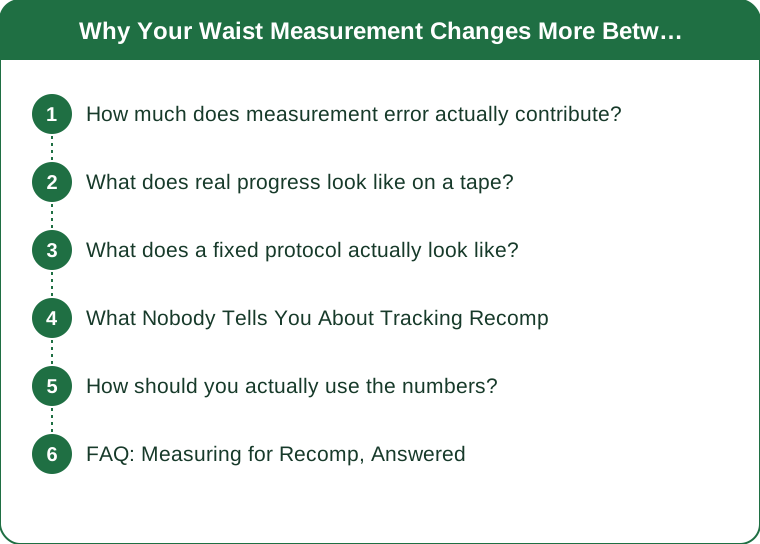
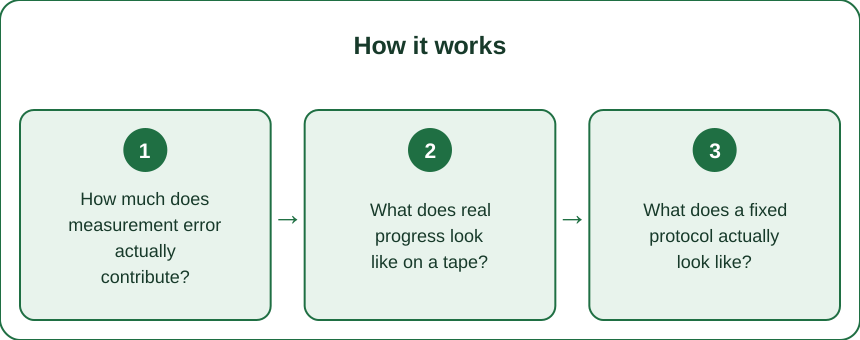
How much does measurement error actually contribute?
Tape tension alone can shift a waist reading by a significant fraction of an inch, and most people vary their pull noticeably between sessions.
Vertical position matters enormously. A centimetre higher or lower on the torso changes the circumference, and freehand placement varies more than that.
Breathing phase adds variation - measuring at the end of an exhale versus a relaxed mid-breath produces different numbers on the same body.
Posture contributes too. Standing tall versus relaxed changes abdominal position and therefore circumference.
Time of day layers on top, since food, fluid, and the day’s activity all change abdominal volume between morning and evening.
Stack all of these and the total error easily exceeds a month of real recomp change, which is why inconsistent measuring produces charts that look like random noise.
What does real progress look like on a tape?
Recomposition changes measurements slowly, typically a small fraction of an inch per month at the waist for someone in a modest deficit.
The signal is small enough that it only appears over eight to twelve weeks, not week to week.
Multiple sites tell you more than one. Waist, hips, thigh, and arm together produce a pattern that any single site cannot.
Direction matters more than magnitude in the early months - consistent small movement in the expected direction is the evidence, not the size of any one change.
Expect flat stretches. Measurements often hold for weeks and then move, and reacting to each flat period is the fastest way to abandon a plan that was working.
And this is exactly why photos and clothes fit are useful companions - they integrate change across the whole body rather than sampling one circumference.
What does a fixed protocol actually look like?
Same tape every time. Different tapes have different widths, stiffness, and stretch, and a fabric tape stretches measurably over months.
Same anatomical landmark, not a guessed height - the narrowest point, or a fixed distance above the navel, chosen once and written down.
Same time of day, ideally first thing in the morning before eating or drinking, which removes most of the daily fluctuation.
Same breath: normal relaxed exhale, not a held breath and not a deep inhale.
Same tension: snug against the skin without compressing it. A spring-loaded tape removes this variable entirely and is worth the small cost.
And measure three times, then average. If the three readings differ by more than a small margin, something in the protocol is drifting.

What Nobody Tells You About Tracking Recomp
Monthly measuring beats weekly. More frequent data does not produce more information when the noise exceeds the signal - it produces more opportunities to misread.
Cycle phase changes measurements meaningfully for menstruating people, so comparing the same phase month to month removes a large and predictable source of variation.
Sodium and carbohydrate intake in the previous forty-eight hours affect fluid retention, and that shows up at the waist before it shows anywhere else.
A cold room changes posture and tissue slightly, which is a small effect that still counts when you are chasing fractions.
Having someone else measure you is more consistent than measuring yourself, because self-measurement changes your posture in the act of doing it.
Photos in identical conditions are more informative than most people expect - same light, same time, same clothing, same position - and they capture what a tape at one height cannot.
And the scale, measurements, photos, and strength numbers disagree with each other constantly. That is normal. Recomp is precisely the situation where they should disagree.
How should you actually use the numbers?
Set the protocol once and write it down, including landmark height, time, breath, and which tape.
Measure monthly on a fixed date rather than whenever you remember, since irregular intervals make trends harder to read.
Track the trend across three months before drawing any conclusion about whether the plan is working.
Use waist alongside body weight and at least one strength number, because recomp is the case where weight alone is actively misleading.
Replace a fabric tape yearly. Stretch develops gradually and produces a slow false improvement that is easy to believe.
And decide in advance what would change your plan. Deciding after seeing a number is how people talk themselves into unnecessary changes. This is general information, not medical advice.
FAQ: Measuring for Recomp, Answered
How often should I measure?
Monthly. Weekly measuring produces more noise than information because real change is smaller than measurement error.
Where exactly should I measure my waist?
Pick one landmark and keep it - the narrowest point or a set distance above the navel. Consistency matters more than which one you choose.
Should I measure morning or evening?
Morning, before eating or drinking. It removes most of the daily fluctuation.
Why did my waist go up when I am clearly making progress?
Fluid, food volume, cycle phase, or a protocol drift. Look at the three-month trend rather than one reading.
Is a spring-loaded tape worth it?
Yes. Tension is one of the largest sources of error and it removes that variable entirely.
Should I trust the scale or the tape?
Neither alone during recomp. Use weight, measurements, photos, and strength together - they are meant to disagree in this situation. This is general information, not medical advice.
TL;DR:
- Measurement error at the waist routinely exceeds a full month of genuine recomp progress.
- Tape tension, landmark height, breathing phase, posture, and time of day each contribute more than the change you are looking for.
- A fixed protocol - same tape, landmark, time, breath, tension, three readings averaged - is what turns noise into signal.
- Measure monthly, not weekly, and read the three-month trend rather than any single number.
- Replace fabric tapes yearly; they stretch and produce a slow false improvement.
Write the protocol down. A protocol you remember differently each month is not a protocol. This is general information, not medical advice.
Keep Reading
This article is for general informational and styling purposes only. Fit, sizing, and product availability may vary.