Why the Scale Jumps When Training Volume Rises
Quick Answer: Increasing training volume raises muscle glycogen storage, and glycogen holds roughly three grams of water per gram stored. Add the inflammatory fluid response to unaccustomed training, and a kilogram or more of scale weight can appear within two weeks of a genuine training increase — while body fat is unchanged or falling. It resolves on its own, usually within three to four weeks, and it is one of the worst possible moments to change your plan.
Week one of the new programme, you felt strong. Week two, you got on the scale and it had gone the wrong way by more than a kilogram.
Almost everyone quits somewhere in the next ten days.

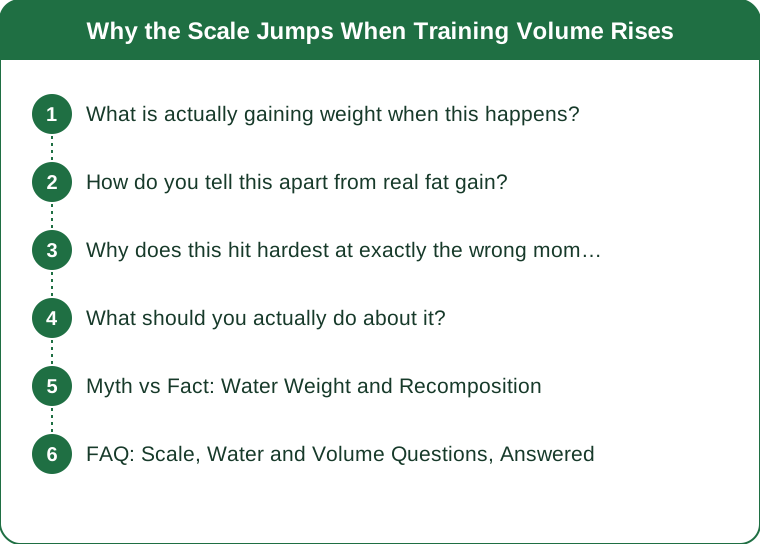
What is actually gaining weight when this happens?
Water, mostly, and it is stored in a specific place for a specific reason.
Muscle stores carbohydrate as glycogen, and glycogen is stored with water — approximately three grams of water per gram of glycogen, though the exact ratio varies. When you increase training volume, your muscles adapt by storing more glycogen, because more work requires more available fuel. That is a positive adaptation and it is also a weight gain.
The amount is not trivial. A well-trained person can store several hundred grams more glycogen than an untrained one, and with the associated water, the total can easily reach a kilogram or more of scale weight across a few weeks of increased training.
There is a second mechanism running at the same time. Unaccustomed training produces a temporary inflammatory response in the muscle, and part of that response is local fluid accumulation. This is the same process behind the swollen, heavy feeling in the legs two days after a hard first session, and it also registers on a scale.
A third, smaller factor: increased training usually means increased food, which means more food volume in the digestive tract at any given time, plus the sodium and water that comes with it.
None of these three is fat. All three appear within one to two weeks and all three are reversible. Actual fat gain requires a sustained energy surplus, and it accumulates at a far slower rate than a kilogram in a fortnight from a training increase alone.
How do you tell this apart from real fat gain?
By the timing, the pattern and the measurements that are not the scale.
Timing is the strongest signal. Fluid and glycogen changes appear within days of a training change and stabilise within two to four weeks. Fat gain from a modest surplus accumulates gradually and continues for as long as the surplus does. A sharp step up that then plateaus is fluid; a slow steady climb that keeps going is not.
Measurements are the second signal, and they are more useful than the scale here. If waist measurement is stable or falling while scale weight rises, the added weight is not abdominal fat. If the tape is climbing along with the scale over several weeks, that is a different conversation.
How your training is going is the third. If lifts are progressing, sessions feel strong and recovery is reasonable, the extra weight is supporting the work. If performance is flat and the weight is climbing, look at the food side.
Clothing fit is a reasonable proxy with a caveat: glycogen-loaded legs genuinely fill leggings differently, which is why people often report clothes feeling tighter in the thigh and looser in the waist during a volume increase. That combination is close to diagnostic.
The practical protocol is unexciting. Weigh daily, average across seven days, and compare weekly averages rather than individual readings. A single reading during a volume increase carries almost no information. A four-week trend of weekly averages carries a lot.
Why does this hit hardest at exactly the wrong moment?
Because the size of the effect scales with how big a change you made, and the people who make the biggest changes are the ones most invested in the outcome.
Someone adding a fourth session to an existing three-session week will see a small effect. Someone going from nothing to four sessions a week will see the full effect, because they are filling glycogen stores that were partially empty and generating a substantial inflammatory response from entirely unaccustomed work.
That is a description of almost every person starting a serious training block in September. The autumn restart is the single most common moment for this to happen, and the reason so many restarts end in week three.
There is a compounding factor. People who restart training frequently also restart eating better at the same time, and that often means more vegetables, more fibre and more carbohydrate from whole foods — all of which increase digestive contents and water retention in the short term. Three separate weight-increasing mechanisms arrive in the same fortnight, all of them signs that things are going well.
And then the scale delivers a verdict that contradicts every one of them, at the exact point where motivation is most fragile. The people who continue are usually the ones who happened to know this was coming.

What should you actually do about it?
Almost nothing, which is harder than it sounds.
Do not cut calories further in response. This is the most common reaction and the most damaging one, because it reduces the fuel available for the training that just increased, which degrades performance and recovery precisely when both need support. A larger deficit does not remove glycogen water in any useful way; it removes your ability to complete the sessions.
Do not increase training further either. Adding more volume in response to a scale reading compounds the same effect and raises injury risk during the adaptation window.
Do keep measuring, and change the measure. Waist and hip measurement fortnightly, a photograph monthly in the same light and position, and weekly weight averages. Three imperfect measures that disagree are far more informative than one precise measure that is wrong.
Do give it four weeks. The glycogen and fluid effect stabilises, and once it has, the trend line underneath becomes visible again. What people describe as the scale finally moving in week five is usually the scale having been accurate all along, with a fixed offset added in week one.
And do write down what you expect before you start. A note that says I expect to gain up to a kilogram in the first fortnight and it will be water, written on the day you begin, is remarkably effective three weeks later when you have forgotten you knew this.
If weight change is rapid, unexplained, or accompanied by swelling, breathlessness or other symptoms, that is a medical question rather than a training one. This is general information, not medical advice.
Myth vs Fact: Water Weight and Recomposition
Myth: Water weight is not real weight, so it does not count.
Fact: It is real mass and it will show up on any scale — it is simply not fat, and it is not permanent. Dismissing it as not real leads people to expect the scale to read fat directly, which no scale does.
Myth: Drinking less water reduces water retention.
Fact: It generally does the opposite, and it degrades training performance immediately. Fluid balance is regulated, and reduced intake tends to increase retention rather than decrease it.
Myth: You can gain muscle fast enough to explain a kilogram in two weeks.
Fact: Realistic muscle gain rates are far slower than that — a fraction of a kilogram per month for most people, less for the well-trained. If the scale moved a kilogram in a fortnight, it was not muscle either. This matters because the muscle explanation is a comforting one that leads people to expect the weight to keep climbing usefully, and it will not.
Myth: Cutting carbohydrate solves it.
Fact: Cutting carbohydrate depletes glycogen and does drop scale weight quickly, which is why low-carbohydrate diets produce dramatic first-week results. It also reduces training capacity during a volume increase, which is the worst possible trade. The weight comes back the moment carbohydrate does, and nothing about body composition changed in either direction.
Myth: The scale is useless, so stop weighing.
Fact: The scale is a good instrument used badly. Daily readings averaged weekly, interpreted alongside measurements and performance, are genuinely useful. Single readings interpreted alone are the problem, not the device.
FAQ: Scale, Water and Volume Questions, Answered
How long does the water weight actually last?
The glycogen component stays as long as the training volume does, because it is an adaptation rather than a temporary swelling. The inflammatory fluid component resolves within two to four weeks as your body adapts to the new work. So part of it goes and part of it stays, and the part that stays is a sign of a better-fuelled muscle.
Should I weigh myself at all during a training increase?
Yes, but daily and averaged, and with the explicit expectation that the first three weeks will be misleading. Some people find it easier to stop weighing for four weeks and use measurements instead. Both are defensible; picking one and sticking to it is the important part.
Does creatine make this worse?
Creatine increases intramuscular water and typically adds around one to two kilograms of scale weight in the first weeks of use. If you started creatine at the same time as increasing training volume, expect the effects to stack, and do not attribute the total to either one alone.
Why do my legs look bigger, not smaller?
Glycogen and fluid are stored in the muscles being worked, so a lower-body-heavy programme produces visible fullness in the legs. It reads as size and it is largely water. Over a few months of consistent training the underlying composition change becomes the dominant effect.
Is there any way to avoid this?
Increasing volume gradually over several weeks rather than all at once spreads the effect out and makes it less alarming, and it is better practice for injury risk anyway. It does not eliminate it, because the adaptation is the point.
What if the weight keeps climbing after six weeks?
Then it is worth looking honestly at intake, because the fluid and glycogen explanation has expired. A slow continuing climb past the adaptation window is usually a modest energy surplus, and it is fixable without drama once identified.
TL;DR:
- Increased training volume raises muscle glycogen, which stores about three grams of water per gram — a kilogram of scale weight in two weeks is normal and is not fat.
- Inflammatory fluid from unaccustomed work and increased food volume stack on top of it, all within the same fortnight.
- Fluid appears fast and plateaus; fat gain accumulates slowly and continues. The shape of the curve is the tell.
- Do not cut calories or add volume in response — both make the underlying situation worse.
- Use weekly weight averages plus waist measurement plus training performance, and give it four weeks.
Write down today what you expect the scale to do over the next fortnight, and read it back in three weeks. This is general information, not medical advice.
Keep Reading
This article is for general informational and styling purposes only. Fit, sizing, and product availability may vary.