Why Recomp Progress Gets Harder to See in Autumn
Quick Answer: Recomposition is slow enough that it is normally tracked by proxy signals — how clothes fit, how you look in a mirror, and photos. Autumn breaks all three at once: layered clothing hides shape, indoor lighting changes what a mirror shows, and photos are taken in worse light with more clothes on. Add seasonal water retention and the scale becomes noisier too. The fix is switching to measurements and strength numbers, which are unaffected by the season.
Eight weeks ago you could see it working.
Now the same eight weeks of effort produces no visible evidence at all.
The progress did not stop. The instruments did.

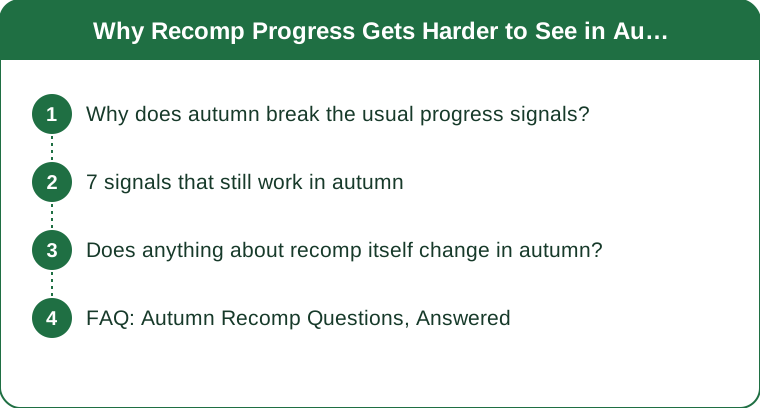
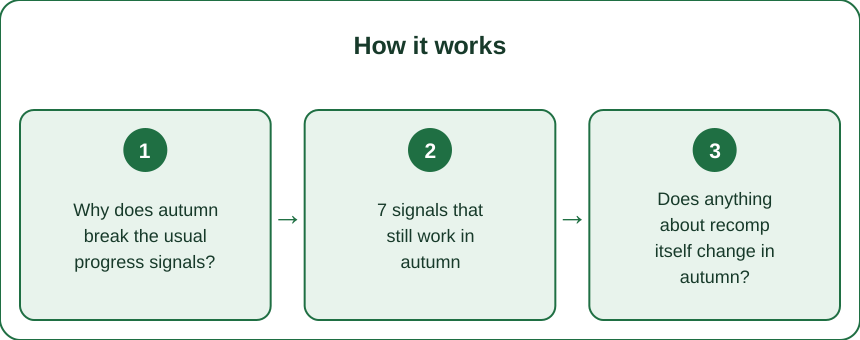
Why does autumn break the usual progress signals?
Because three of the four are visual, and autumn changes what you can see.
Clothing fit is the most commonly used recomp signal and the first to go. Structured autumn fabrics do not follow the body’s contours the way summer jersey does, so the fit feedback becomes vague. A knit that fits a range of measurements tells you nothing about which end of the range you are at.
Mirror assessment degrades with the light. Overhead and dim indoor lighting reduces contrast and definition, which is precisely what a visual check depends on. The same body in October’s ceiling light looks different from July’s window light, and the difference is larger than most people’s monthly progress.
Progress photos become uncomparable. The value of a photo series comes entirely from consistency of light, angle, and time of day, and autumn quietly changes all three.
And the scale gets noisier. Seasonal shifts toward higher-carbohydrate, higher-sodium eating increase stored water — glycogen binds several grams of water per gram — so a real change is masked by a larger fluctuation.
Which leaves one signal intact: what you can measure and what you can lift. Those are unaffected by light, clothing, or season, and this is the point in the year to start relying on them.
7 signals that still work in autumn
Ranked by how reliable they are and how little effort they require.
-
Waist circumference, monthly. It fluctuates far less than weight and correlates well with the change you are actually after. Same time of day, same conditions, relaxed not sucked in.
-
Working set loads at a fixed rep range. If your 8-rep squat has gone up while your weight has not, that is recomposition happening, and it is unambiguous.
-
Weekly average weight rather than daily. Averaging seven readings removes most of the water noise, and the trend line is readable even when the days are not.
-
Hip and thigh measurements alongside waist. The waist-to-hip relationship changing tells you more than either number alone.
-
A single fixed garment used as a gauge. Not the whole wardrobe — one item, the same one, kept as an instrument. A pair of non-stretch trousers works best.
-
Total training volume, tracked. Sets times reps times load, per muscle group, per week — rising volume with stable body weight is the mechanism recomp runs on.
-
Photos, but taken deliberately. Same spot, same time, same light source, same clothing, once a month. The effort of standardising them is what makes them worth taking at all.
What nobody tells you: recomposition at a maintenance calorie intake is slow enough that a fortnightly check produces mostly noise. Monthly is the right cadence for measurements, and it feels too infrequent, which is why people abandon it.

Does anything about recomp itself change in autumn?
Two things do, and both are addressable.
Non-exercise activity falls, which changes your maintenance calories. Daily step counts drop measurably in autumn and winter, and non-exercise activity is a substantial and variable part of daily energy expenditure. A maintenance intake calculated in July is often a small surplus in November without anything else changing.
Protein intake gets less consistent. Schedule changes displace anchor meals, and protein is the macronutrient most dependent on deliberate meal construction. Recomp is more protein-sensitive than either fat loss or bulking, because you are asking for muscle gain without a calorie surplus to help.
Sleep changes for some people. Reduced morning light delays circadian timing, and short sleep is associated with reduced fat loss and poorer training performance.
Training usually survives intact, which is why people are confused — the visible input has not changed while two invisible ones have.
Practical adjustments: protect the step count first (it is the largest of the three), rebuild a protein anchor into the new schedule, and get morning daylight exposure which helps both sleep timing and activity. None of these require changing the training programme.
FAQ: Autumn Recomp Questions, Answered
Is recomposition actually possible, or should I pick one goal?
It is possible and it is slow. Simultaneous fat loss and muscle gain is best documented in beginners, people returning after a break, and people with higher body fat — trained lifters near their genetic ceiling see much less. Adequate protein, progressive resistance training, and a roughly maintenance calorie intake are the conditions. For an advanced lifter, dedicated phases are usually more efficient.
How fast should I expect to see change?
In the region of months rather than weeks. Muscle gain even under favourable conditions is measured in small fractions of a kilogram per month, and at maintenance calories it is slower still. This is why the measurement cadence matters — a weekly check on a process this slow produces noise that looks like failure.
Should I switch to a cut for winter instead?
Only if you would actually adhere to it. A deficit is easier to measure progress in, which is psychologically useful when the visual signals are gone. But winter adherence to a deficit is harder for most people, and an abandoned cut is worse than a continued recomp. Match the plan to the season you will actually live through.
Does body fat scale or smart scale data help?
Use the trend, not the number. Bioimpedance readings are strongly affected by hydration, food, and time of day, and the absolute body fat percentage should not be taken seriously. The direction of a long-run trend measured under identical conditions has some value, and it is still less reliable than a tape measure.
TL;DR:
- Recomp is normally tracked by clothing fit, mirror, and photos — autumn degrades all three at once.
- Seasonal water retention from higher-carbohydrate eating makes the scale noisier too.
- Waist circumference monthly and working set loads are unaffected by season and are the signals to switch to.
- Weekly average weight removes most of the water noise; daily readings do not.
- Falling step counts turn a July maintenance intake into a November surplus without anything else changing.
- Protein anchors get displaced by schedule changes, and recomp is more protein-sensitive than other goals.
Switch to a tape measure and a training log for three months, and the progress you cannot see becomes the progress you can read.
Keep Reading
This article is for general informational and styling purposes only. Fit, sizing, and product availability may vary.