Why Your Strength Climbs While the Scale Refuses to Move
Quick Answer: A stalled scale during a period of rising strength usually means you are gaining muscle and losing fat at roughly the same rate - the definition of recomposition. Body weight is a sum of many things, and two of its components moving in opposite directions produces no net change. Strength gains, better fit in clothes, and stable weight together are one of the clearest recomposition signals there is. The scale is measuring the wrong variable for what you are doing.
Most people in this exact situation conclude nothing is happening.
It is often the period when the most is.

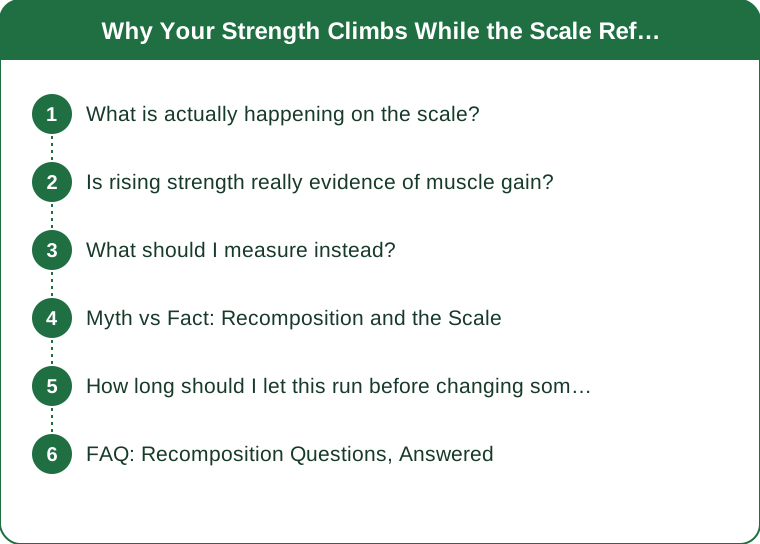
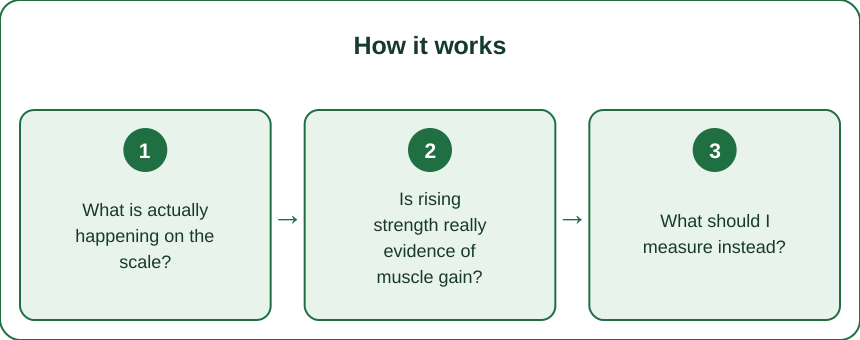
What is actually happening on the scale?
Two opposing changes cancelling out, plus a lot of noise.
Body weight is a sum of muscle, fat, water, glycogen, bone, organs, and the contents of your digestive tract. When one component rises and another falls by a similar amount, the total does not move even though the composition has changed substantially.
Muscle and fat differ in density, not in some magic ratio. Muscle tissue is denser than fat, so a pound of muscle occupies noticeably less space than a pound of fat. Swapping four pounds of fat for four pounds of muscle leaves your weight identical and changes your measurements and how clothes fit visibly.
Then there is water, which swamps everything short term. Daily fluctuations of two to four pounds from water and glycogen are completely normal, driven by sodium, carbohydrate intake, training, sleep, and hormonal cycles. That variation is often larger than a month of genuine composition change.
Training itself adds water. New or increased training causes muscle to hold more glycogen, and each gram of glycogen is stored with roughly three grams of water. Someone starting a new program frequently gains a couple of pounds in the first two weeks that is entirely water.
So a flat scale during rising strength is not a contradiction. It is the expected reading when composition is changing and mass is not.
Is rising strength really evidence of muscle gain?
Partly - and the timeline matters for interpreting it.
Early strength gains are mostly neural. In the first six to ten weeks of a program, most improvement comes from better recruitment and coordination rather than new tissue. Strength can rise sharply with very little muscle change.
Sustained strength gains beyond that window are much more likely to reflect actual muscle. If your lifts have been climbing steadily for four or five months, tissue is being added, even if the scale disagrees.
The most convincing pattern is strength rising while weight is flat and measurements are shrinking. Waist measurement down, lifts up, weight unchanged - that combination is difficult to explain any other way.
Recomposition is most pronounced in three groups: people new to resistance training, people returning after a break, and people with more body fat to lose. For a lean, long-trained person, simultaneous gain and loss is much slower and harder - which is why the same advice does not fit everyone.
And the rate is genuinely slow. Muscle gain for a trained person is often measured in a pound or two per month at best, and considerably less for women than the internet suggests. Against normal daily water variation of several pounds, that signal is invisible on a scale week to week.
What should I measure instead?
Four things, none of which is daily weight.
1. Training performance. Weight lifted, reps completed, quality of movement. This is the most sensitive and most immediate indicator you have and it costs nothing but a notebook.
2. Circumference measurements, monthly. Waist at the navel, hips at the widest, thigh, and upper arm. Same time of day, same conditions. Waist is the single most useful because it tracks fat change closely for most people.
3. Photos, monthly, same conditions. Same spot, same lighting, same time of day, same clothing. Monthly rather than weekly - change is invisible at a week and obvious across three months.
4. How clothes fit. Unfashionable as a metric and genuinely informative. Jeans that fit differently at the same body weight is direct evidence of composition change.
If you do weigh yourself, weigh daily and look at the weekly average. A single daily reading is mostly noise; a seven-day average is a usable trend. Comparing this week’s average to the average three weeks ago tells you something real.
And consider not weighing at all for a training block. For many people the daily number costs more in frustration than it delivers in information. Twelve weeks of tracked lifts and monthly photos will tell you more.

Myth vs Fact: Recomposition and the Scale
Myth: Muscle weighs more than fat. Fact: A pound is a pound. Muscle is denser, so the same weight takes up less space. This is why measurements change while weight does not.
Myth: You cannot build muscle and lose fat at the same time. Fact: You can, and it is most pronounced in beginners, returners, and people with more fat to lose. For lean, well-trained people it is slow and difficult but not impossible.
Myth: A stalled scale means a stalled program. Fact: A stalled scale with rising strength and falling measurements means the program is working exactly as intended. The scale is simply not the right instrument.
Myth: You need to eat in a deficit to lose fat during recomposition. Fact: A small deficit or maintenance intake with high protein and progressive training is the common approach. A large deficit undermines the muscle-building side and often stalls strength.
Myth: Body composition scales at home settle the question. Fact: Bioimpedance scales are heavily influenced by hydration and produce readings that vary substantially day to day. They can show a trend over months and should not be trusted for a single reading.
How long should I let this run before changing something?
Longer than most people do - and there are specific signals for when to change.
Give it a minimum of eight to twelve weeks before drawing conclusions. Recomposition is slow by nature. Judging it at four weeks is judging noise.
Keep going if: lifts are progressing, measurements are moving in the right direction, energy and sleep are good, and you are eating enough protein. That is a working program regardless of the scale.
Change something if strength has been flat for three consecutive weeks and measurements have not moved either. Then the likely culprits, in order: not enough protein, not enough total food, not enough progressive overload, or not enough sleep.
Check protein first because it is the most common gap. Roughly 1.6 to 2.2 grams per kilogram of body weight daily is the range that supports this, and most people who think they are hitting it are not.
Then check whether training is actually progressive. Doing the same weights for the same reps for two months is not a stimulus. Recomposition needs the muscle-building signal to be real.
And check sleep honestly. Sleep restriction measurably impairs both muscle gain and fat loss and is the most commonly ignored variable in the whole equation.
One seasonal note: as days shorten, activity outside of training often falls without anyone noticing - fewer walks, less time outdoors, more sitting. That drop in daily movement is frequently what stalls an autumn recomposition, not the training program.
FAQ: Recomposition Questions, Answered
How fast can recomposition realistically happen?
Slowly. A pound of muscle per month is a good rate for someone past the beginner stage, and fat loss at maintenance calories is similarly gradual. Meaningful visual change usually takes three to six months.
Should I eat at maintenance or in a deficit?
Maintenance or a small deficit, with protein high and training progressive. A large deficit prioritises fat loss at the cost of the muscle side and typically shows up as stalled or falling strength.
Why do my measurements change but not my photos?
Photos need bigger changes to be visible, and lighting and posture vary more than people control for. Same spot, same light, same time of day, monthly - and compare across three months rather than one.
TL;DR:
- A flat scale with rising strength usually means muscle up, fat down, mass unchanged.
- Muscle is denser than fat, so measurements and fit change before weight does.
- Daily water and glycogen swings of two to four pounds are larger than a month of real change.
- Track lifts weekly, measurements and photos monthly, and use a seven-day weight average if you weigh at all.
- Give it eight to twelve weeks before changing anything; check protein, progression, and sleep first.
Measure your waist today and write it down with your current lifts. In eight weeks that pair will tell you everything the scale cannot.
Keep Reading
This article is for general informational and styling purposes only. Fit, sizing, and product availability may vary.