Why Your Step Count Collapses During a Recomp Before Your Training Does
Quick Answer: When energy intake sits at or below maintenance, the body quietly reduces non-exercise activity thermogenesis (NEAT) — fidgeting, walking, standing, general movement. Step counts commonly drop 15 to 30% within six weeks without any conscious decision, which can wipe out 200 to 400 calories a day. Training performance holds up because your body protects prioritised activity and cuts the unmonitored kind. Track steps as a metric, not just as a habit.
The training log looks great. You are hitting every session and adding weight.
The scale has not moved, the mirror has not moved, and by the strict definition of recomposition that should be fine — except the measurements have not moved either.
You did not eat more. You did not train less. Something quietly changed anyway, and it is not in your training log because it was never in your training log.

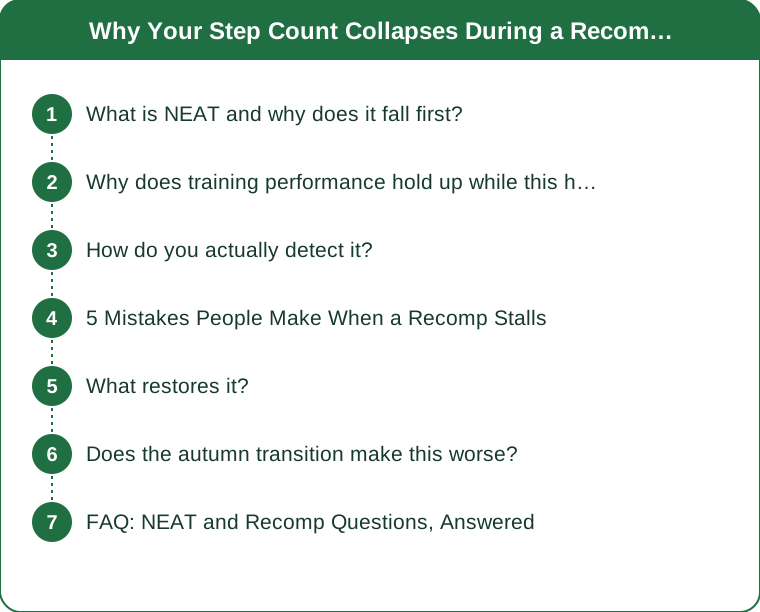
What is NEAT and why does it fall first?
NEAT is every calorie you burn that is not sleeping, eating or deliberate exercise.
Walking to the kitchen. Standing while on the phone. Taking stairs. Fidgeting. Gesturing. Pacing. For most people NEAT accounts for 15 to 30% of total daily energy expenditure, and unlike training it is almost completely unconscious.
That unconsciousness is exactly the problem. When energy availability drops, the body reduces spending, and it starts with the spending you are not watching.
The mechanism is well-documented: reduced energy intake lowers leptin and thyroid signalling, which reduces spontaneous movement drive. You do not decide to sit down more. You just find yourself sitting more, taking the lift more, standing still while you wait rather than pacing.
The scale of it is the surprise. Studies of overfeeding and underfeeding show NEAT can vary by several hundred calories a day between individuals in the same conditions. In a recomp, where the whole plan runs on a narrow energy margin, a few hundred calories is the entire margin.
Why does training performance hold up while this happens?
Because training is protected and NEAT is not.
Two reasons. First, training is deliberate. You have decided to do it, it is scheduled, and you show up regardless of how you feel. Your body cannot quietly opt out of a session the way it can opt out of standing up.
Second, resistance training is a relatively small energy cost. A hard 60-minute session might cost 250 to 350 calories. That is significant, but it is comparable to the amount NEAT can silently shed in a day.
So the pattern people report is entirely consistent: lifts climbing, energy in the gym fine, and everything outside the gym gradually flattening. You feel a bit less inclined to walk to the shop. Evenings feel more sedentary. None of it registers as a decision.
This is also why training performance is a poor early-warning signal for a stalled recomp. It is the last thing to go.
How do you actually detect it?
Look at data you already have.
Pull your six-week step history. Every phone and watch has it. Compare the four weeks before you started against the last two weeks. A drop of 1,500 to 3,000 steps a day is common and is worth roughly 60 to 150 calories.
Look beyond steps. Steps miss standing time, fidgeting and general movement, which can be a larger share of NEAT than walking. If your watch reports standing hours or active minutes, check those too.
Check the shape of your day. Most NEAT decline shows up in the evening, after training and after work, when nothing is prompting movement.
Watch for the soft signs: taking the lift without thinking about it, driving a distance you would have walked, sitting through phone calls you used to pace through, wearing a jumper indoors instead of moving to warm up.
A useful benchmark: if your average daily steps have fallen more than 15% since the block started, that is your stall, not your training.

5 Mistakes People Make When a Recomp Stalls
1. Cutting calories further. This is the intuitive move and it makes NEAT decline worse, since lower energy availability is the trigger. You end up with a smaller deficit than you had before, from a lower intake.
2. Adding cardio sessions. Formal cardio partially substitutes for lost NEAT rather than adding to it — people who add a run often move less for the rest of that day. Restoring NEAT directly is more efficient.
3. Adding training volume. More sessions cost more recovery, which reduces spontaneous movement further. Recomp already demands more volume than a cut, and there is a ceiling.
4. Trusting the tracker’s calorie estimate. Wearable calorie figures for daily expenditure are rough. Use step count and active minutes as trend data, not as absolute numbers.
5. Assuming a stall means the plan is wrong. Very often the plan is fine and the execution has quietly drifted in a way no log captured. That first mistake — cutting further — is the one that turns a two-week stall into a three-month one.
What restores it?
Structure, because spontaneity is exactly what is being suppressed.
Set a step floor, not a step goal. A floor of, say, 8,000 is something you check and correct; a goal is something you hit or miss. Check it at 6pm, when there is still time to act.
Attach walks to existing events. Ten minutes after each meal is the most reliable structure there is, and it adds roughly 3,000 steps across a day.
Take a maintenance break. Two weeks at genuine maintenance calories restores leptin signalling and, with it, spontaneous movement. Recomps generally need a maintenance block before they need a plan change.
Do not count the walks as training. Keep them low intensity so they do not add to recovery cost. The point is restoring background movement, not adding another session.
Check sleep. Short sleep reduces next-day spontaneous activity substantially, and recomp is more sleep-sensitive than either cutting or bulking.
Does the autumn transition make this worse?
It is arguably the single biggest seasonal effect on body composition, and it is almost entirely a NEAT effect.
Daylight drives outdoor movement. As sunset moves earlier through September and October, evening walks disappear from a lot of routines. That change is worth thousands of steps a week for many people.
Cold reduces incidental outdoor time. Errands become drives. Waiting outside becomes waiting inside. Weekend movement drops most of all.
Comfort behaviour rises. Evenings shift toward sitting, and that is precisely the window where NEAT decline is already concentrated.
The combination is a recomp stall that looks like a plan failure and is actually a calendar effect. Typical autumn step decline is 10 to 20% for people without a deliberate structure.
The seasonal fix: move your walking to daylight hours before you lose them — a lunchtime walk survives autumn far better than an after-dinner one — and build indoor movement into evenings deliberately.
FAQ: NEAT and Recomp Questions, Answered
How many steps should I actually be aiming for?
There is no universal number. The relevant target is your own baseline before the block started. Maintaining that is the goal; chasing an arbitrary 10,000 is not.
Does a standing desk help?
Modestly. Standing burns only slightly more than sitting, but standing correlates with more incidental movement — shifting, pacing, stepping away — and that is where the value is.
Should I stop tracking and just eat more?
If the stall has persisted more than four weeks and steps have fallen, a two-week maintenance block plus restored walking usually resolves it. Eating more without restoring movement solves the physiology and undoes the deficit.
This is general information, not medical advice.
TL;DR:
- Reduced energy availability quietly suppresses NEAT, and step counts commonly fall 15 to 30% within six weeks with no conscious decision.
- Training performance holds because deliberate activity is protected — it is the last signal to fail, not the first.
- Detect it by comparing your six-week step history, and look at evenings specifically.
- Fix it with a step floor, post-meal walks and a two-week maintenance block — not by cutting further or adding cardio.
- Autumn compounds it: earlier sunsets alone cost most people 10 to 20% of their daily movement.
Your training log was never going to catch this. The step history on the phone in your pocket already has.
Keep Reading
This article is for general informational and styling purposes only. Fit, sizing, and product availability may vary.