Why Your Recomp Stalls When Your Sleep Slips Before Your Diet Does
Quick Answer: Body recomposition asks two opposite things of your body at once - build muscle and lose fat - and both processes depend heavily on recovery hormones and training quality that sleep controls. When sleep drops, muscle protein synthesis falls, appetite regulation gets noisier, and training output quietly declines. The diet did not fail. The recovery that made the diet work did. Sleep is the cheapest recomp variable and the first one people stop measuring.
Here is the sequence it actually follows, and how to tell sleep-driven stalling from real plateau.

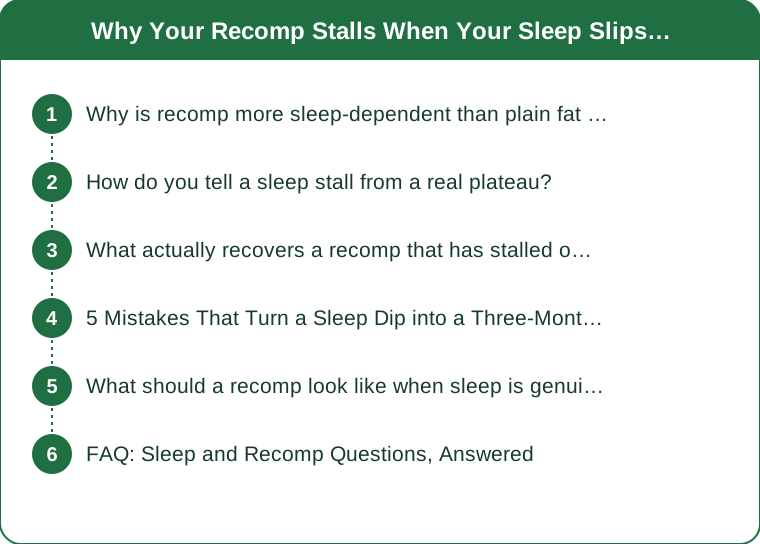
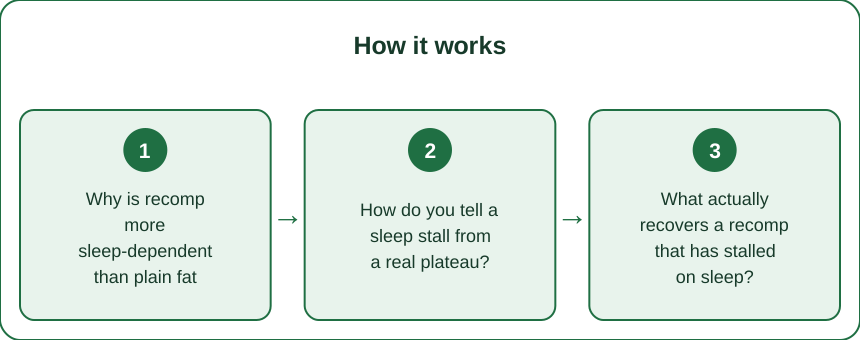
Why is recomp more sleep-dependent than plain fat loss?
Because you are asking for two adaptations that pull in opposite directions, and only one of them is optional to your body under stress.
Fat loss mostly needs an energy deficit. It happens, imperfectly, even when recovery is poor - your body will give up tissue when energy is short. Muscle gain needs an actual construction process, and construction is what gets deprioritised first when the system is under-recovered.
Muscle protein synthesis is elevated during sleep and is sensitive to sleep restriction. When you shorten sleep, more of the weight you lose in a deficit comes from lean tissue rather than fat - which is precisely the outcome recomp is designed to avoid.
Training quality falls before it feels like it falls. Under-slept lifters produce fewer quality reps, lose reps at the same load, and rate the same session as harder. The stimulus that drives the muscle side of recomp shrinks while the workout still looks identical in your log if you only record sets and weight.
And appetite regulation gets noisier. Short sleep shifts hunger and fullness signalling in the direction of eating more, particularly of energy-dense food. You do not become undisciplined. The signal you are exercising discipline against gets louder.
Put together: the deficit still works, the muscle side stops working, and recomp becomes plain weight loss - which looks like a stall in the mirror even when the scale is moving.
How do you tell a sleep stall from a real plateau?
They look identical on the scale and different everywhere else.
A real plateau shows up as energy balance drifting closed - your maintenance dropped, your non-exercise movement declined, portions crept up. Training performance holds steady or improves. Strength is flat or rising, session RPE is normal, and you feel fine.
A sleep stall shows the opposite signature. Weight may still be dropping while the mirror stops changing - the lean tissue is going with the fat. Same-load sets feel harder, your last set drops a rep or two, and warm-ups feel heavy at weights that were easy a month ago.
Check three markers over a week rather than a day. Reps at a fixed load in one main lift. Perceived effort on the same session. And morning appetite - a sharp increase in early hunger is a common sleep-restriction signature.
Track total sleep opportunity, not just how you feel. Most people over-estimate their sleep by close to an hour, because time in bed is not time asleep. Anything that shortens the window - a later bedtime, an earlier alarm, a new schedule - compounds across weeks in a way that a single bad night does not.
And check when the stall started against when your schedule changed. Late-August routine shifts - the end of the summer schedule, school starting, earlier alarms, travel back from holiday - land almost exactly where a lot of people notice recomp stopping, and the timing is not a coincidence.
What actually recovers a recomp that has stalled on sleep?
Sequence matters, because the instinct is to fix the wrong variable.
Do not cut calories further. This is the near-universal first response and it makes the problem worse - a larger deficit on top of poor recovery accelerates lean tissue loss and further degrades training quality.
Extend sleep opportunity by 30 to 60 minutes before changing anything else. Give it two weeks. This is the highest-leverage change available and it costs nothing.
Protect the earliest hour, not the latest. Going to bed 40 minutes earlier is far more reliable than trying to sleep later, because your wake time is usually fixed by something you do not control.
Reduce training volume before you reduce training intensity. Fewer hard sets at the same load preserves the strength stimulus while cutting recovery cost. Dropping the weight preserves volume and loses the signal - which is backwards for recomp.
Raise protein slightly if it is below roughly 1.6g per kg of body weight. Higher protein intake is protective of lean mass during a deficit, and it matters more when recovery is compromised, not less.
And accept a maintenance phase if sleep genuinely cannot improve right now. A stressful month with a fixed early alarm is a poor time to attempt recomp. Holding your position for four weeks is a legitimate outcome and it preserves the muscle you already built, which is what you will restart from.

5 Mistakes That Turn a Sleep Dip into a Three-Month Stall
1. Cutting calories in response. The stall reads as too much food, so the deficit gets deeper. Under-recovered plus under-fed is the fastest route to losing the muscle you spent months building. If the stall arrived alongside worse sleep, food is the last thing to change.
2. Adding cardio to force the issue. More sessions on less sleep adds recovery cost to a system already short of recovery. Extra low-intensity walking is fine; extra hard conditioning is not, and the distinction is the one people ignore.
3. Judging progress by the scale during a recomp. Recomp is the one goal where the scale is close to useless - muscle gained and fat lost can cancel out completely for weeks. Measurements, photos in the same light, and how clothes fit are the real instruments here.
4. Not counting the caffeine you added to cope. Poor sleep leads to more coffee, later. Caffeine has a long half-life and afternoon doses measurably reduce sleep quality, which deepens the original problem. The 3pm cup that gets you through the session is often what costs you the recovery from it.
5. Treating one good night as a fix. Recovery from accumulated sleep debt takes more than a single long night. The relevant unit is the weekly average, and a week of six hours is not repaired by one nine-hour Saturday - though the Saturday does help.
And the one that surprises people: the weekend catch-up sleep that feels restorative also shifts your body clock later, making Monday and Tuesday nights harder - so the pattern that seems like the solution partly reproduces the problem. Consistency across seven days beats a big weekend correction.
What should a recomp look like when sleep is genuinely limited?
Sometimes the sleep cannot change - a new baby, shift work, a demanding season. The right move is to change the goal, not to force the plan.
Pick one direction rather than two. Recomp is the most recovery-expensive body composition goal there is. A small deficit aimed at fat loss alone, or maintenance calories aimed at strength alone, both work better under poor recovery than trying to do both badly.
Cut frequency before you cut effort. Three quality sessions beat five degraded ones. The sessions you actually recover from are the ones that count.
Keep the deficit small - roughly 10 to 15% below maintenance rather than 25%. Slower fat loss with muscle preserved beats faster loss that costs lean tissue you then have to rebuild.
Anchor the things that are free. Consistent wake time, morning daylight within an hour of waking, and a fixed caffeine cut-off around eight hours before bed. These do not require more time in bed and they improve the quality of the sleep you do get.
Re-evaluate monthly, not weekly. Under constrained recovery, weekly data is mostly noise. A monthly measurement and photo comparison is a fairer read of whether the approach is working.
And treat the constrained period as a holding pattern with a clear end. Knowing you will restart the recomp when the schedule opens up - after the term settles, after the travel, after the season changes - makes maintenance feel like a strategy rather than a failure.
This is general information, not medical advice. Persistent poor sleep, loud snoring with daytime sleepiness, or unexplained fatigue alongside weight change are worth raising with a healthcare professional - sleep apnoea and thyroid issues both produce exactly this picture and neither is fixed by training changes.
FAQ: Sleep and Recomp Questions, Answered
How much sleep do I actually need for body recomposition?
Most adults do best on seven to nine hours of actual sleep, which means a longer time-in-bed window. The exact number matters less than consistency - a stable seven hours beats a swing between five and ten.
Can I still lose fat on poor sleep?
Usually yes - fat loss largely follows the energy deficit. What suffers is the muscle side, so more of the weight lost tends to come from lean tissue. That is why the scale can move while the mirror does not.
Should I train if I slept badly last night?
One bad night is fine to train through, usually with slightly reduced volume. A run of bad nights across a week is different, and that is when cutting sets rather than pushing through is the better call.
Why am I hungrier when I am short on sleep?
Sleep restriction shifts appetite and fullness signalling toward eating more, particularly energy-dense food. It is a physiological change, not a willpower problem, which is why fighting it with stricter rules rarely works.
Does weekend catch-up sleep fix the week?
Partly. It reduces accumulated debt but also shifts your body clock later, making the start of the next week harder. Consistent timing across all seven days works better than a large weekend correction.
How long before improved sleep shows in the mirror?
Training quality often improves within a week. Visible body composition change takes longer - give an extended sleep window a full four weeks before judging it, and compare photos rather than the scale.
TL;DR:
- Recomp asks for muscle gain and fat loss at once, and the muscle side is what your body deprioritises when recovery is short.
- Under short sleep, more of the weight you lose comes from lean tissue - so the scale moves while the mirror stalls.
- Training quality drops before it feels like it drops: fewer quality reps at the same load, higher perceived effort.
- Tell them apart by reps at a fixed load, session RPE, and morning appetite - a sleep stall degrades all three, a true plateau does not.
- Do not cut calories further. Extend sleep opportunity by 30 to 60 minutes and give it two weeks first.
- Cut volume before intensity, keep protein around 1.6g/kg or above, and skip added hard cardio.
- If sleep genuinely cannot improve, pick one goal instead of two and treat maintenance as a strategy with an end date.
The stall usually started the week your schedule changed - not the week your discipline did.
This is general information, not medical advice.
Keep Reading
This article is for general informational and styling purposes only. Fit, sizing, and product availability may vary.