Why Your Waist Measurement Can Shrink Weeks Before the Scale Ever Moves
Quick Answer: During body recomposition, fat loss and muscle gain can happen simultaneously at similar rates, meaning total body weight stays relatively flat while body composition and measurements genuinely change — the scale reflects only total mass, while a tape measure and how clothes fit reflect the composition shift more directly and often show change weeks earlier.
This lag confuses a lot of people into thinking progress has stalled, when measurements are often already showing the opposite.

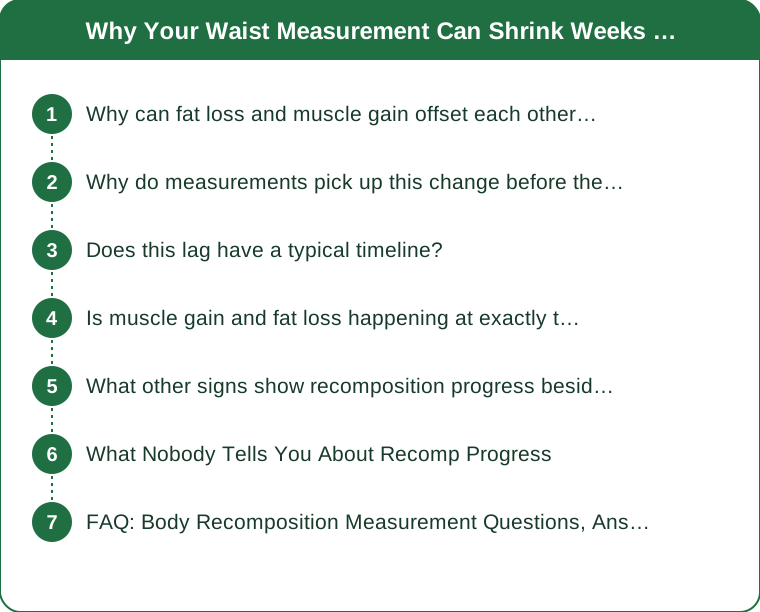
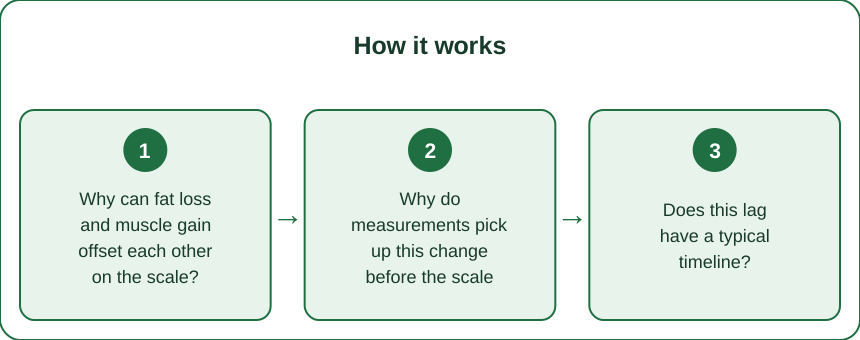
Why can fat loss and muscle gain offset each other on the scale?
Muscle tissue is denser than fat tissue, meaning a given volume of muscle weighs more than the same volume of fat. During recomposition, losing a pound of fat while gaining roughly a pound of muscle keeps total scale weight essentially unchanged, even though body volume and shape have measurably changed.
Why do measurements pick up this change before the scale does?
A tape measure captures volume and shape directly — as fat is lost around the waist specifically, that measurement shrinks regardless of what’s happening with total body mass elsewhere, making it a more immediate and specific indicator of localized change than total body weight.
Does this lag have a typical timeline?
It varies, but many people doing consistent strength training and nutrition tracking see measurable waist or clothing-fit changes within 3-6 weeks, while scale weight can remain flat for considerably longer during the same period, sometimes months.

Is muscle gain and fat loss happening at exactly the same rate realistic?
Not usually exactly equal, but close enough over weeks to months to keep the scale relatively flat, particularly for beginners or people returning to training after a break, who tend to see faster simultaneous muscle gain and fat loss than more advanced trainees.
What other signs show recomposition progress besides measurements?
Progress photos (in consistent lighting and pose), how clothes fit, and strength progression in the gym all tend to reflect recomposition progress more reliably than scale weight during this phase, since they’re not confounded by the muscle-fat weight offset.
What Nobody Tells You About Recomp Progress
Many people stop a genuinely working program because the scale hasn’t moved, not realizing that a flat scale during consistent training and eating is often a sign recomposition is actively happening, not a sign of failure — the data that would show success (measurements, photos) usually isn’t being tracked as consistently as the scale.
FAQ: Body Recomposition Measurement Questions, Answered
How often should measurements actually be taken during a recomp phase?
Every 2-4 weeks is usually enough to see a meaningful trend without over-focusing on short-term noise, which measurements (like scale weight) can also have day to day.
Which body measurements are most useful to track besides the waist?
Hips, thighs, and arms are commonly tracked alongside waist, giving a fuller picture of where composition changes are occurring.
At what point should a flat scale become a concern rather than expected recomp behavior?
If measurements and strength are also flat for 8+ weeks despite consistent training and nutrition, it’s worth reassessing the program rather than assuming recomp is still quietly working.
TL;DR:
- Simultaneous fat loss and muscle gain can keep scale weight flat despite real progress
- Muscle’s higher density than fat means volume and mass tell different stories
- Measurements often show change weeks before the scale reflects anything
- Progress photos and strength gains are additional reliable indicators during this phase
If your scale hasn’t moved but your training and eating have been consistent, grab a tape measure before assuming nothing’s working — recomposition often shows there first.
Keep Reading
This article is for general informational and styling purposes only. Fit, sizing, and product availability may vary.