Why Your Clothes Fit Differently Before the Scale Moves at All During Recomp
Quick Answer: Because recomposition involves simultaneous fat loss and muscle gain, total bodyweight can stay flat even while body shape and clothing fit change significantly — the scale measures total mass, not the ratio of fat to muscle that’s actually shifting.
Your jeans are looser in the waist and tighter through the thigh in a way that feels new, but the scale number hasn’t budged in three weeks — and that’s not a contradiction, it’s exactly what recomp is supposed to look like.

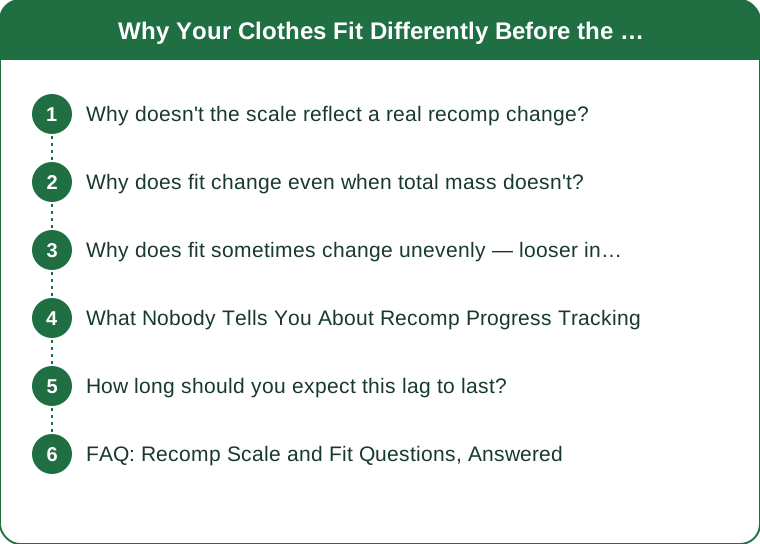
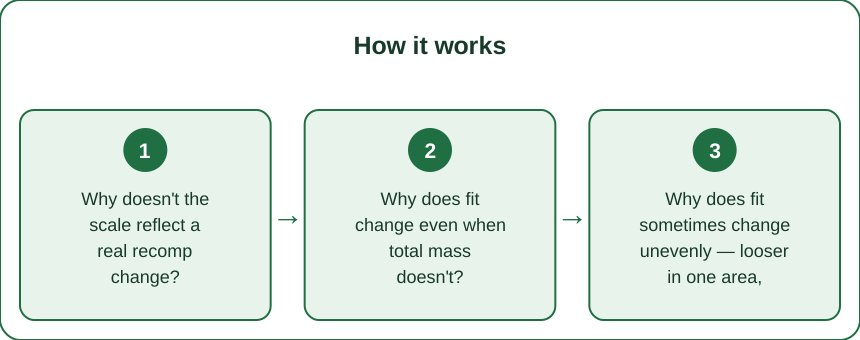
Why doesn’t the scale reflect a real recomp change?
The scale measures total mass — fat, muscle, water, everything combined — with no ability to distinguish what kind of tissue changed. If you lose roughly a pound of fat and gain roughly a pound of muscle in the same stretch, the scale shows zero net change even though your actual body composition shifted meaningfully.
Why does fit change even when total mass doesn’t?
Muscle and fat take up different amounts of space per pound — muscle is denser and more compact, fat is more voluminous per unit of weight. So even at an identical total bodyweight, a body with more muscle and less fat measures smaller in circumference, which is exactly why clothes fit differently well before any scale change registers.
Why does fit sometimes change unevenly — looser in one area, tighter in another?
Fat loss and muscle gain don’t happen uniformly across the body at the same rate — many people lose fat first from certain areas (often the midsection, for hormonal and individual-pattern reasons) while gaining visible muscle in trained areas like the glutes, shoulders, or thighs. That combination explains looser-waist, tighter-thigh jeans specifically — it’s two different processes showing up in two different places at once.

What Nobody Tells You About Recomp Progress Tracking
Progress photos and simple tape measurements (waist, hip, thigh) are more sensitive early indicators than the scale during a recomp phase, precisely because they capture shape change that the scale can’t. Many people abandon a working recomp plan because they’re only checking the one metric (scale weight) that’s structurally unable to show the change happening.
Also underrated: how your clothes fit is itself a legitimate, if informal, measurement tool — tracking which specific pieces feel different over time gives real signal, not just a mood boost.
How long should you expect this lag to last?
For most people running a well-structured recomp (adequate protein, consistent resistance training, roughly maintenance-level calories), visible fit changes commonly appear within 4-8 weeks, while a meaningful scale change may take considerably longer or, in some cases, may never be large if fat loss and muscle gain stay closely matched throughout.
FAQ: Recomp Scale and Fit Questions, Answered
Should I stop weighing myself during a recomp phase?
Not necessarily, but weighing yourself daily and expecting it to track progress will likely be discouraging — weekly weigh-ins alongside measurements and photos gives a more complete picture.
Is it possible to recomp without any scale change at all for months?
Yes, particularly for people newer to resistance training, where the ratio of fat lost to muscle gained tends to run closer to even.
What’s the most reliable non-scale way to track recomp progress?
A consistent set of 3-4 tape measurements taken monthly under the same conditions, paired with progress photos in similar lighting and pose.
TL;DR:
- The scale measures total mass, not the fat-to-muscle ratio that recomp actually changes
- Muscle is denser than fat, so identical weight can measure smaller in circumference
- Fat loss and muscle gain often happen unevenly across different body areas at once
- Track measurements and photos alongside the scale, not the scale in isolation
Keep Reading
This article is for general informational and styling purposes only. Fit, sizing, and product availability may vary.