Why the Bathroom Scale Is Especially Misleading During Body Recomposition
Quick Answer: Body recomposition involves simultaneously losing fat and gaining muscle, and because muscle tissue is denser than fat tissue, someone can lose a meaningful amount of body fat while gaining a comparable amount of muscle weight, producing little to no net change on the scale despite a genuinely improved body composition — this is precisely why scale weight is one of the least reliable single metrics for tracking recomposition progress specifically.
A stalled scale during body recomposition often isn’t a stalled result — it’s simply the scale being asked to measure a change it isn’t actually equipped to detect.

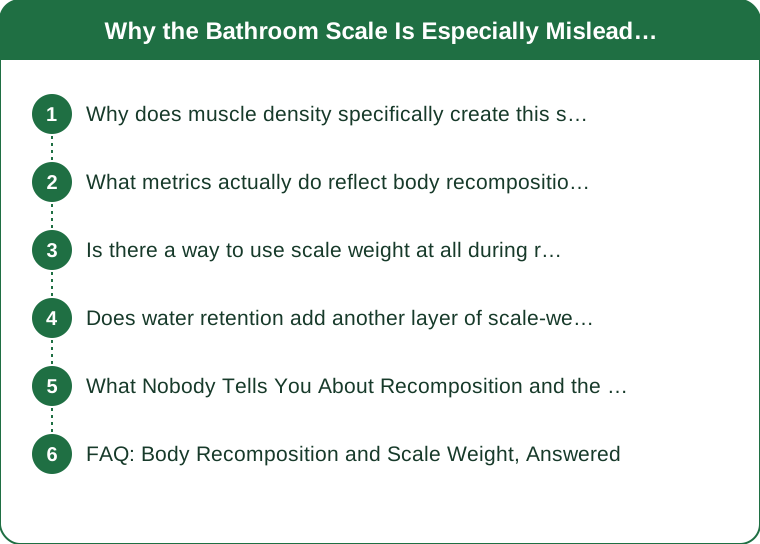
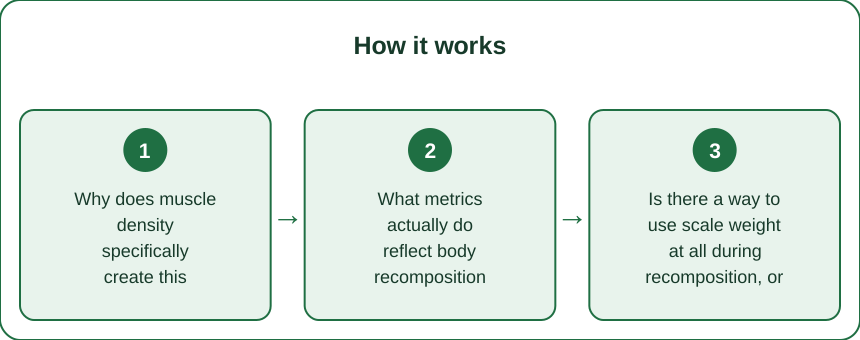
Why does muscle density specifically create this scale-weight blind spot during recomposition?
Muscle tissue is denser than fat tissue, meaning a given volume of muscle weighs more than the same volume of fat. During recomposition, someone might lose, for example, three pounds of fat while gaining three pounds of muscle — a body volume decrease and visible physique change, despite the scale showing zero net weight change, since the scale only measures total mass, not the composition or volume of that mass.
What metrics actually do reflect body recomposition progress more reliably than scale weight?
Body measurements (waist, hips, thighs), progress photos taken consistently under the same lighting and pose, and how clothing fits all capture volume and shape changes that scale weight misses entirely. For those with access, body composition tracking methods like DEXA scans or reliable bioelectrical impedance devices provide a more direct fat-versus-muscle breakdown, though even simple measurements and photos meaningfully outperform scale weight alone for this specific goal.
Is there a way to use scale weight at all during recomposition, or should it be ignored completely?
Scale weight can still serve as one data point among several, tracked as a trend over weeks rather than a single reading, since a completely flat trend over a long period alongside no other measurable changes might still indicate genuinely stalled progress, not error, worth investigating. The key adjustment is not treating scale weight as the primary or sole indicator, given how directly it can mask genuine recomposition progress.

Does water retention add another layer of scale-weight unreliability specifically during a period of increased training?
Yes — starting or increasing strength training often causes temporary water retention in newly worked muscles as part of the adaptation and repair process, which can add scale weight independent of any fat or muscle change at all. This effect is usually most pronounced in the first few weeks of a new or increased training stimulus and typically stabilizes as the body adapts, adding yet another reason scale weight alone is a poor short-term recomposition indicator.
What Nobody Tells You About Recomposition and the Scale
A completely flat or even slightly increased scale weight during the first several weeks of a well-designed recomposition program is actually a fairly common, expected pattern, not necessarily a sign of a stalled or failed approach — many people abandon an otherwise working recomposition plan specifically because they misread this normal pattern as failure, when measurements and photos over the same period would often show real, encouraging progress.
FAQ: Body Recomposition and Scale Weight, Answered
How long should someone expect to see little to no scale weight change during a genuine, working recomposition phase?
This varies by individual, but several weeks of minimal net scale change alongside real training consistency isn’t unusual and doesn’t by itself indicate a stalled approach, especially early on.
Are body measurements really more reliable than scale weight for tracking this specific kind of change?
Yes — measurements directly reflect body volume and shape, which is what visibly changes during recomposition, making them meaningfully more informative than a single total-mass number.
Does this scale-weight unreliability apply to fat loss alone, without a simultaneous muscle-building component?
Less so — pure fat loss without a significant simultaneous muscle-building phase tends to show up on the scale more reliably, since there’s no comparable muscle-weight gain offsetting the fat loss in that scenario.
TL;DR:
- Muscle’s greater density than fat means recomposition can occur with little to no net scale weight change
- Body measurements, progress photos, and clothing fit capture volume changes the scale misses entirely
- New or increased training can add temporary water retention, further muddying short-term scale readings
- A flat scale during early, consistent recomposition training is a common, often misleading normal pattern
The scale isn’t built to detect the specific kind of change body recomposition produces — tracking measurements and photos instead gives a far more honest, encouraging picture of real progress.
Keep Reading
This article is for general informational and styling purposes only. Fit, sizing, and product availability may vary.