Why Body Recomposition Can Show No Change on the Scale for Weeks While Genuinely Working
Quick Answer: During body recomposition the scale can sit still for weeks because you’re losing fat and gaining muscle at similar rates, and a scale only measures total mass — it can’t tell the two apart. Track waist and hip measurements plus monthly progress photos alongside weight, and judge progress by whether those numbers move, not the scale.
You’re training consistently. You’re eating at maintenance. You’ve done everything the plan asked for, for six weeks. And the scale reads within a pound of where it started.
That’s not a stall. That’s frequently what working looks like.

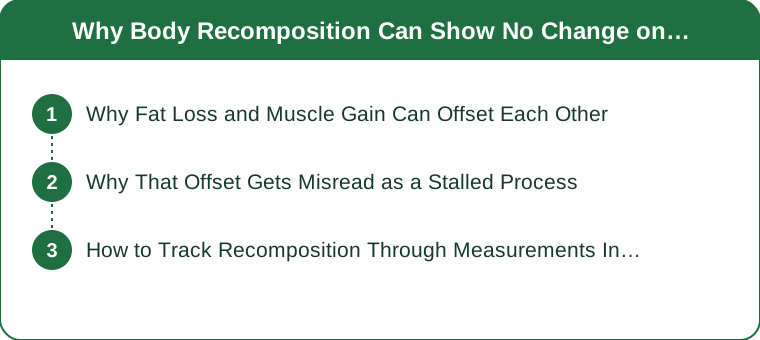
Why Doesn’t the Scale Move During Body Recomposition?
Because two opposite changes are happening at once and canceling out in the one number you’re watching.
Lose a pound of fat, gain a pound of muscle, and the scale reads exactly the same. Not approximately the same — the same, because a bathroom scale measures total mass and has no mechanism for distinguishing what that mass is made of. It’s a scale. It weighs things.
Here’s what makes this genuinely confusing: a pound of muscle takes up noticeably less space than a pound of fat. Muscle sits around 1.06 g/cm³ against fat’s roughly 0.9 g/cm³, so muscle is denser by about 15–18%. Swap a pound of one for a pound of the other and your body gets smaller while weighing identically. That’s why the jeans start fitting differently in a month where the scale did nothing at all.
Recomposition rates are modest, too. A trained-but-not-advanced lifter in a maintenance-calorie phase might realistically gain 0.25–0.5 lb of muscle a month while losing a similar amount of fat. Those two numbers landing close together is not an accident — it’s the intended outcome of the protocol.

Why Does a Flat Scale Get Misread as a Stalled Plan?
Because a flat number over multiple weeks looks exactly like nothing happening, and there’s nothing on the readout to say otherwise.
Six weeks of the same number feels like unambiguous evidence. It reads as the plan doesn’t work. And the very reasonable response to that — cut calories harder, add cardio, change everything — is often precisely the wrong move, because it turns a working recomposition phase into an aggressive deficit where you start losing the muscle you were building.
There’s a second layer of noise on top. Daily weight swings of 2–4 pounds are completely normal and have nothing to do with fat or muscle: sodium intake, carbohydrate stored as glycogen (each gram of glycogen holds roughly 3 grams of water), menstrual cycle phase, hydration status, and how recently you trained. A single hard leg session can add a pound of retained water for two days.
So you’re trying to detect a 0.3 lb monthly signal inside a 3 lb daily noise band. The scale isn’t lying, exactly. It’s just answering a question you didn’t ask.
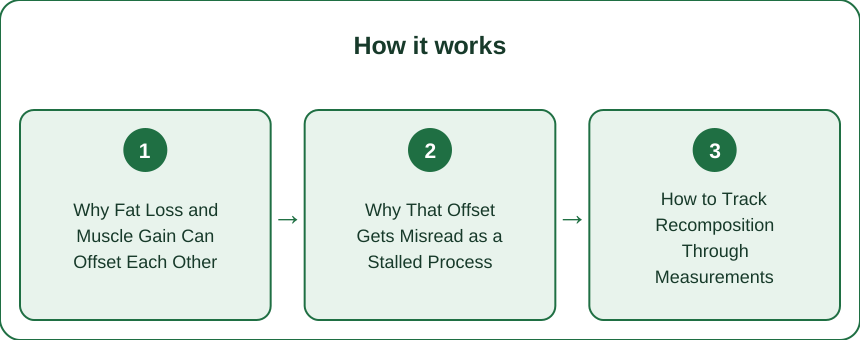
How Do You Track Body Recomposition Without the Scale?
Add metrics that can actually separate fat and muscle instead of blending them into one number.
Tape measurements, monthly, same conditions. Waist at the navel, hips at the widest point, one thigh, one upper arm. Measure first thing in the morning, before eating, on the same day of the month. Waist shrinking while weight holds steady is close to a textbook recomposition signature.
Progress photos, monthly, same everything. Same lighting, same time of day, same clothing, same three angles, relaxed rather than flexed. Do not compare week to week — you can’t see 0.3 lb of muscle, and you’ll only frustrate yourself. Compare month three to month one.
Gym performance logs. If your working weight on a squat or press has gone up across eight weeks at a steady bodyweight, you gained functional strength while not gaining mass. That’s a composition change with a paper trail.
How clothes fit. Unscientific and genuinely useful. Waistbands are a surprisingly sensitive instrument.
Keep weighing yourself if you like — just weigh daily and read the weekly average, not any single day. Averaging is what pulls a real trend out of the water-weight noise.
Myth vs. Fact
Myth: Muscle weighs more than fat. Fact: A pound is a pound. Muscle is denser, so a pound of it occupies about 15–18% less volume. That’s the whole effect, and it’s the reason your measurements can drop on a flat scale.
Myth: You can’t build muscle and lose fat at the same time. Fact: You can, most reliably if you’re relatively new to training, returning after a break, or carrying higher body fat. It gets slower and harder the more trained you are, but “slower” isn’t “impossible.”
Myth: A stalled scale means eat less. Fact: During an intentional maintenance-calorie recomposition phase, a flat scale is the expected result. Cutting harder in response can undercut the protein and energy availability that muscle gain depends on.
Myth: Body fat scales settle the question. Fact: Consumer bioimpedance scales are heavily influenced by hydration and can swing several percentage points day to day. Use one for trend direction over months if you like, but don’t treat a single reading as data.
FAQ
How long does body recomposition take to show visible results?
Most people need 8–12 weeks before photos show a clear difference, and closer to 4–6 months for changes that other people notice. It’s slower than either a straight cut or a straight bulk, which is the tradeoff you accept for changing composition without changing the number much.
Should I weigh myself daily or weekly during recomp?
Daily, but only ever read the 7-day average. Daily weighing gives you enough data points to average away water fluctuation; weekly weighing gives you one reading that could easily land on a high-sodium day and tell you something false.
What if my waist measurement isn’t moving either?
Then it’s worth reviewing the inputs — most commonly, calories are genuinely above maintenance rather than at it, or protein is low. A practical target is roughly 0.7–1.0 g of protein per pound of goal bodyweight, with progressive overload in the training log. If both are solid and nothing has moved in 12 weeks, that’s a reasonable point to consult a registered dietitian.
General fitness information, not medical or nutrition advice. Individual results vary considerably with training history, age, sleep, and health status.
TL;DR:
- A scale measures total mass and can’t distinguish fat from muscle — losing one while gaining the other reads as zero
- Muscle is ~15–18% denser than fat, so you can get visibly smaller at an identical weight
- Daily weight noise (2–4 lb) is far larger than the monthly recomposition signal (~0.3 lb)
- Track monthly tape measurements, monthly photos, and gym performance instead
- If you weigh, weigh daily and read the 7-day average — never a single day
Keep Reading
This article is for general informational and styling purposes only. Fit, sizing, and product availability may vary.