Why the Same Recomp Plan Works at 30 and Stalls at 45
Quick Answer: Recomp depends on muscle protein synthesis responding to training and protein. With age, that response becomes blunted — the same protein dose and the same training stimulus produce a smaller signal. The fix is more protein per meal, more total training volume with adequate recovery, and considerably more patience, not a harder deficit.
The program that reshaped you in your early thirties is the same program. You are doing it just as consistently. And after twelve weeks the mirror looks essentially unchanged, which is a very specific kind of frustrating.

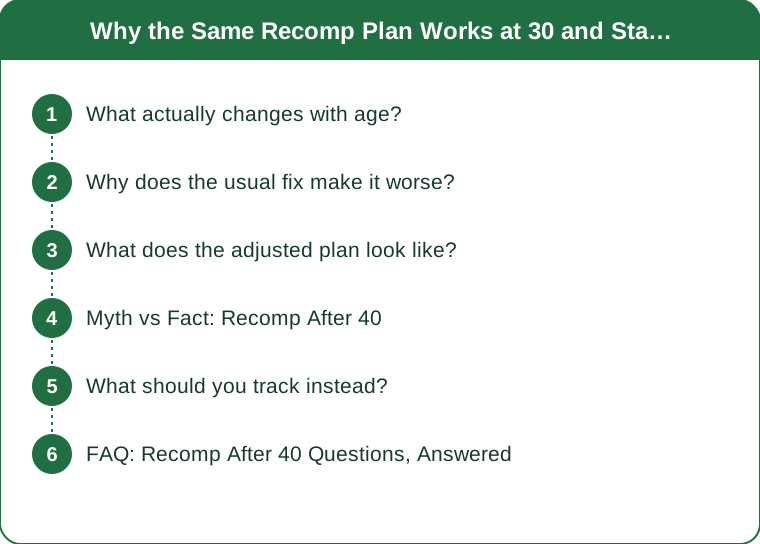
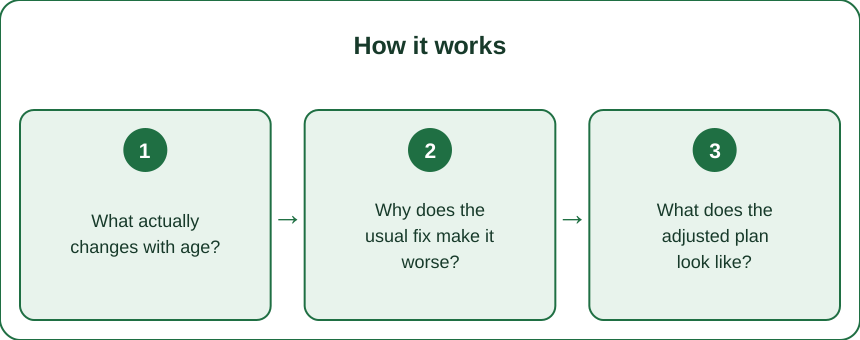
What actually changes with age?
Three things, and they compound rather than adding.
Anabolic resistance. This is the central mechanism. Muscle tissue becomes less responsive to the two signals that build it — dietary protein and mechanical loading. The same 20-gram protein dose that reliably triggered muscle protein synthesis at 25 produces a weaker response at 50, which is why per-meal protein recommendations rise with age.
Hormonal shifts. In the perimenopausal transition, declining estrogen affects muscle protein turnover, fat distribution, insulin sensitivity, and recovery. This is not a small variable and it is often the one nobody mentioned.
Recovery capacity. Not dramatically reduced, but reduced enough that a program built on five hard sessions a week may now be producing accumulated fatigue rather than accumulated adaptation.
What has not changed much: your ability to build muscle in absolute terms, given adequate stimulus. The muscle-building machinery still works; it just needs a louder signal to switch on. That distinction matters, because it points at a completely different fix than the one most people reach for.
Why does the usual fix make it worse?
Because the instinct is to eat less, and eating less attacks the exact mechanism that is already struggling.
When the mirror does not change, most people cut calories. In a recomp — where the goal is losing fat and gaining muscle simultaneously — a deeper deficit reduces the energy available for muscle protein synthesis, increases muscle protein breakdown, and reduces training performance, which reduces the stimulus.
In your thirties you could get away with that because the anabolic signal was strong enough to overcome a moderate deficit. With anabolic resistance in play, a deep deficit tips the balance and you end up losing weight that includes lean tissue, which makes the mirror look worse rather than better even as the scale moves.
The secondary mistake is adding cardio at the expense of lifting. Cardio is genuinely useful, and if it displaces resistance training or interferes with recovery from it, you have removed the primary stimulus in favor of the secondary one.
The correct direction is almost the opposite of the instinct: eat more protein, lift more, run a shallower deficit, and extend the timeline.
What does the adjusted plan look like?
Four changes, in order of how much difference each makes.
1. Protein per meal, not just per day. The general target of 1.6 to 2.2 g/kg still applies, and the distribution requirement tightens. Aim for 30 to 40 grams per meal across three or four meals, since the per-meal threshold to trigger synthesis is higher than it used to be. A day totaling 120 grams delivered as 15, 25, and 80 is meaningfully worse than 35, 40, 45.
2. More total resistance volume, distributed better. Two hard sessions a week is a maintenance dose. Three to four, with most sets taken close to but not to failure, produces a much stronger signal. Full-body sessions three times a week outperform a split for most people at this stage, because each muscle group gets stimulated more often.
3. A shallower deficit, held longer. A 10 to 15 percent deficit rather than 20 to 25. Slower, and it preserves the lean tissue that is the entire point.
4. Recovery treated as programming, not as a reward. Sleep genuinely affects muscle protein synthesis and appetite regulation, and it is the variable most often traded away.

Myth vs Fact: Recomp After 40
Myth: Your metabolism has slowed down dramatically. Fact: Large studies of total energy expenditure find it stays remarkably stable from roughly 20 to 60 when adjusted for body composition. What usually changes is lean mass and daily movement, both of which are addressable. Metabolic rate is not the villain here.
Myth: You cannot build muscle after menopause. Fact: You absolutely can, and resistance training remains effective at every age studied. The rate is slower and the requirements are higher, which is a different statement from impossible.
Myth: You need to train harder than you did at 30. Fact: You need to train more, with better recovery — not harder within each session. Grinding sessions to failure raises fatigue cost more than it raises stimulus, and fatigue cost is where the constraint now sits.
Myth: Twelve weeks should show clear results. Fact: At 30, often yes. At 45 in a recomp, twelve weeks may show strength gains, better fit in specific garments, and very little on the scale. Sixteen to twenty-four weeks is a more honest evaluation window, and judging at twelve is a major reason people abandon plans that were working.
What should you track instead?
The scale is a poor instrument for recomp at any age and a worse one now. Better signals:
- Strength progression. The most reliable early indicator that the training stimulus is landing. If your lifts are climbing, muscle is being built, whatever the scale says
- Waist measurement, taken monthly at the same time of day. It separates fat change from lean change far better than weight does
- Fit in a specific reference garment. One pair of trousers, tried on monthly. More sensitive than a tape measure for most people
- Photos in fixed conditions — same light, same time of day, same position, monthly. Not weekly, and not in whatever bathroom you happen to be in
- Energy and recovery quality, which tells you whether the volume is right
And the timeline expectation, honestly stated: plan in quarters, not weeks. A recomp at 45 done properly shows meaningful visible change over four to six months. The people who succeed at this are almost always the ones who set a six-month horizon at the start rather than the ones who tried harder.
This is general information rather than medical advice — if you are navigating perimenopause, fatigue that is not explained by training, or unexplained changes in body composition, that is a conversation worth having with a physician who takes it seriously.
FAQ: Recomp After 40 Questions, Answered
Should I stop trying to lose fat and just build muscle?
Often a good call, at least for a phase. A period at maintenance calories with high protein and consistent lifting builds lean mass more effectively than any deficit, and lean mass makes the subsequent fat-loss phase work far better. Sequencing beats simultaneity when the anabolic signal is weaker.
Does creatine help at this stage?
Creatine monohydrate is among the most studied supplements available and there is reasonable evidence it supports strength and lean mass gains in older adults alongside resistance training. It is inexpensive and well tolerated for most people. It is not a substitute for the protein and volume changes above.
Why do my results seem to vary so much month to month?
Cycle phase, sleep quality, stress, sodium, and training phase all move water weight and appearance considerably, and those swings become more noticeable when the underlying rate of change is slower. This is exactly why monthly fixed-condition measurements beat daily impressions.
TL;DR:
- Anabolic resistance means the same protein and training produce a smaller muscle-building signal
- The instinct to cut calories harder attacks the exact mechanism that is already struggling
- Raise protein to 30 to 40 grams per meal, lift three to four times weekly, run a shallower deficit
- Track strength, waist, and one reference garment monthly; plan in quarters rather than weeks
The plan did not stop working because you got older. It stopped working because it was calibrated for a system that responded more easily, and recalibrating it is straightforward once you know which dial moved.
Keep Reading
This article is for general informational and styling purposes only. Fit, sizing, and product availability may vary.