Why Recomp Demands More Sleep Than Cutting or Bulking Does
Quick Answer: Body recomposition asks for muscle gain and fat loss simultaneously, and both processes depend heavily on sleep. Muscle protein synthesis peaks during sleep, growth hormone is released in the deepest sleep stages, and short sleep shifts weight loss toward lean tissue rather than fat. In a study where people slept 5.5 hours versus 8.5 hours on the same calorie deficit, the short-sleep group lost a substantially larger share of their weight as lean mass. When you are running both goals at once, sleep stops being recovery and becomes the mechanism.
If recomp has stalled for you and training and food look right, this is the variable most likely to be missing.

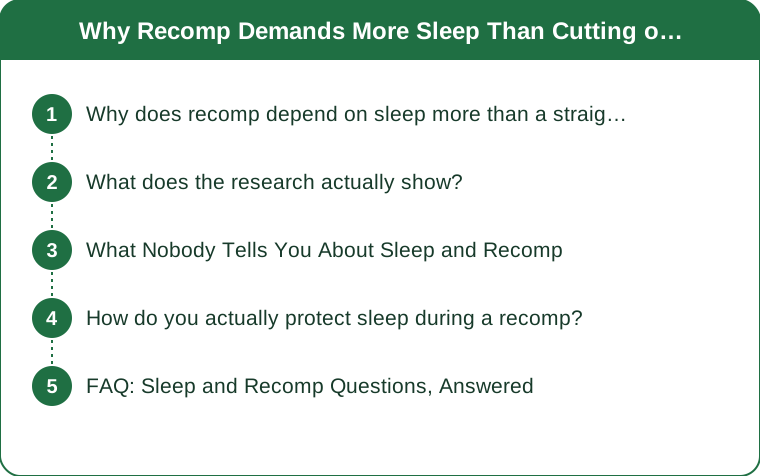
Why does recomp depend on sleep more than a straight cut or bulk?
Because it needs both anabolic and metabolic processes to work well at the same time, and sleep is where both live.
In a bulk, you have a calorie surplus doing much of the work. Even with imperfect sleep, the energy availability drives muscle gain, and some fat gain is accepted as the cost.
In a straightforward cut, the deficit drives fat loss. Muscle preservation matters, and the target is preservation rather than growth, which is a lower bar.
Recomp asks for growth and loss simultaneously, at maintenance or a small deficit. There is no energy surplus to smooth over inefficiency. Every process has to run well, and the biggest lever on how well they run is sleep.
The specific mechanisms:
Growth hormone releases in pulses, with the largest during slow-wave sleep — the deep sleep concentrated in the first half of the night. Cut sleep short and you cut into the sleep architecture that produces it.
Muscle protein synthesis continues overnight and is supported by the overnight recovery period. Sleep restriction has been shown to reduce muscle protein synthesis rates.
Insulin sensitivity drops measurably after even a few nights of short sleep, which affects where nutrients get partitioned — toward muscle or toward fat storage.
Appetite hormones shift, with ghrelin up and leptin down after restricted sleep, which makes maintaining a precise intake substantially harder.
Each of these is manageable in isolation. Stacked, on a plan with no energy surplus to absorb them, they are enough to stall a recomp entirely.
What does the research actually show?
The most cited finding is direct and quite stark.
In a controlled study where participants ate the same calorie-restricted diet under two sleep conditions — 5.5 hours and 8.5 hours in bed — total weight loss was similar between groups. The composition of that loss was not. The short-sleep group lost a considerably larger proportion of their weight as fat-free mass, and less as fat.
That result is the entire recomp problem in one experiment. Same food, same deficit, opposite outcome in the thing you actually care about.
Other findings point the same direction. Sleep restriction studies consistently show reduced insulin sensitivity within days, increased hunger and preference for energy-dense foods, and reduced training performance and motivation.
There is a training-quality dimension too, which is easy to overlook. Short sleep reduces peak force output, increases perceived effort, and slows reaction time. A recomp depends on progressive overload, and progressive overload depends on sessions where you can actually add weight or reps. A run of poor-sleep weeks quietly removes the stimulus that the whole plan is built on.
The honest framing: sleep is not a bonus that makes recomp faster. It is a condition that determines whether the outcome is recomp or simply weight loss with muscle attached.

What Nobody Tells You About Sleep and Recomp
Sleep quality matters as much as duration. Eight hours of fragmented sleep does not deliver the same slow-wave sleep as seven solid hours. If you sleep long and wake unrefreshed, the duration number is hiding the problem.
The first half of the night carries most of the deep sleep. Going to bed later and sleeping in does not fully substitute, because slow-wave sleep is front-loaded. A consistent earlier bedtime beats a longer late one for this specific purpose.
Training late compounds it. A hard evening session raises core temperature and sympathetic activity, and for some people that delays sleep onset by exactly the amount they cannot afford. Recomp is one of the few contexts where session timing genuinely matters.
Alcohol is disproportionately costly here. It reduces slow-wave sleep and suppresses growth hormone release, which is precisely the mechanism recomp is relying on. A moderate amount on a training day costs more during recomp than during a cut.
Under-eating makes sleep worse, which makes recomp worse. A deficit that is too aggressive commonly disrupts sleep, creating a loop where the plan undermines the thing it needs. This is a strong argument for maintenance-or-slightly-below rather than a steep deficit.
The plateau at month two or three often has a sleep explanation. People check calories and program first, because those are visible in a spreadsheet. Sleep is rarely tracked with the same rigor, and it is frequently what changed.
How do you actually protect sleep during a recomp?
Six things, in order of return.
Fix the bedtime, not the wake time. Most people already have a fixed wake time set by work. Consistency at the other end is what is usually missing, and it is what determines total duration.
Target 7 to 9 hours in bed, and treat the lower end as a floor rather than a target. During recomp specifically, aiming at the higher end is justified in a way it may not be during other training phases.
Move hard sessions earlier where you can. If your only training window is evening, finish at least 90 minutes before bed and prioritize a genuine cool-down. This matters more in summer, when both room and core temperature are already elevated.
Keep the deficit small. Recomp works best at maintenance to roughly a 10 percent deficit. Steeper deficits degrade sleep, training quality, and muscle retention simultaneously — the three things recomp cannot afford to lose.
Get protein distributed across the day, including something in the evening. A protein-containing meal or snack in the hours before bed supports overnight muscle protein synthesis, and it also reduces the hunger that wakes people at 3am on a deficit.
Keep the room genuinely cool. Core temperature has to drop to initiate sleep. In late summer this is the single most common sleep disruptor, and it will resolve on its own as the season turns — which is a reason to expect recomp progress to improve over the next several weeks for reasons unrelated to your program.
That last point is worth planning around. If your recomp has been flat through a hot August, do not overhaul the plan yet. Cooler nights are coming, sleep quality typically improves, and the same program may start working again. Changing three variables at once during the worst sleep month of the year makes it impossible to know what helped.
This is general information, not medical advice. Persistent poor sleep despite good habits is worth discussing with a professional.
FAQ: Sleep and Recomp Questions, Answered
Can I make up for poor weeknight sleep at the weekend?
Partially, and not fully. Weekend catch-up sleep restores some performance and alertness, and it does not undo the metabolic effects of five short nights. Consistency beats recovery here.
Is a nap useful during recomp?
Yes, and a 20 to 30 minute nap is genuinely helpful for training quality and does not typically disrupt night sleep. Longer naps can, especially late in the day.
How long before poor sleep shows up in my results?
Hormonal and appetite effects appear within days. Body composition effects take weeks to become visible, which is why sleep is so often ruled out as a cause — the timeline does not feel connected.
TL;DR:
- Recomp needs muscle gain and fat loss at once with no energy surplus to absorb inefficiency, and sleep is where both processes run.
- On the same deficit, short sleep shifts a substantially larger share of weight loss to lean tissue rather than fat.
- Deep sleep is front-loaded in the night, so an earlier consistent bedtime beats a longer late one.
- Keep the deficit small, move hard sessions earlier, get evening protein, and keep the room cool.
If a hot August flattened your progress, wait for the cooler nights before changing your program. The variable that broke may fix itself.
Keep Reading
This article is for general informational and styling purposes only. Fit, sizing, and product availability may vary.