Why Progress Photos Lie to You During a Recomposition
Quick Answer: Photos are extremely sensitive to lighting, time of day, hydration, glycogen, food volume, and posture, and every one of those varies more week to week than genuine recomposition does month to month. Real change during recomposition happens at a rate of roughly half a kilogram of muscle a month at best, which is smaller than the daily noise in any photograph. Use tape measurements, strength numbers, and how clothes fit, and take photos on a strict fixed protocol if you take them at all.
Recomposition is the slowest visible process in fitness, and photos are the highest-variance measurement available. That combination produces a great deal of unnecessary discouragement.
This blog has covered why your clothes fit differently before the scale moves and why your strength climbs while the scale stalls. This is the measurement problem, and it is the reason most people quit a process that was working.


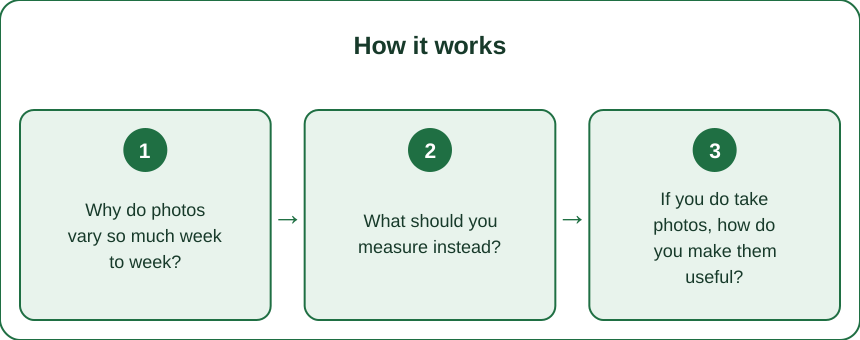
Why do photos vary so much week to week?
Because almost everything that affects a photo has nothing to do with body composition.
Lighting direction is the largest single factor. Overhead light creates shadows that emphasise contour and definition. Flat frontal light removes them entirely. The same body under the two conditions looks meaningfully different in ways that dwarf a month of progress.
Time of day changes your shape genuinely. Morning after an overnight fast is your flattest point. Evening after a full day of eating is your fullest. Comparing across the two is comparing different states.
Muscle glycogen changes how full muscles look. A few days of higher carbohydrate intake makes muscles appear noticeably fuller because glycogen draws water into them. A low-carbohydrate stretch does the reverse. This is a water effect and it looks exactly like gaining or losing muscle.
Sodium and hydration shift water under the skin. A salty meal or poor sleep can produce visible softness that resolves within a day or two.
Posture varies without you noticing. A slight change in how you hold your shoulders, your pelvis, or your breath changes a photo substantially. Most people also stand differently when they feel discouraged, which turns a bad mood into visual evidence of a bad month.
And genuine change is slow. Realistic muscle gain for a trained woman is roughly a quarter to half a kilogram a month distributed across the whole body. That is a very small visual change, and it is smaller than all the noise listed above.
What should you measure instead?
Three things, all more stable and more informative than a photograph.
1. Strength numbers, which are the clearest signal. If your working weights are climbing while your body weight is stable, you are recomposing. This is the most direct evidence available and it is essentially immune to lighting and hydration.
2. Tape measurements at fixed sites. Waist at the navel, hips at the widest point, thigh at a marked distance from the knee, and upper arm. Measure at the same time of day, in the same conditions, once every two weeks rather than weekly.
3. How specific garments fit. Pick one pair of trousers and one fitted top and note how they fit monthly. This integrates changes across your whole body and it is the measure that actually matters day to day.
Watch the combination rather than any single number. Stable weight plus a falling waist measurement plus rising strength is the exact signature of successful recomposition, and no single one of those three would tell you on its own.
Measure every two weeks, not every day. Daily measurement produces noise, and noise produces anxiety and unnecessary program changes. Recomposition operates on a monthly timescale.
And expect the timeline to be long. Meaningful visible change from recomposition typically takes three to six months. Anyone showing dramatic photo changes over four weeks changed water, lighting, and posture, not tissue.

If you do take photos, how do you make them useful?
By controlling every variable except the one you are trying to see.
Same time of day, always. First thing in the morning, after using the bathroom, before eating or drinking. This is the most reproducible state your body offers.
Same location and same light. Mark where you stand and where the phone goes. Use a room with consistent artificial light rather than daylight, which changes with season and weather.
Same distance and same phone height. Waist height, roughly two metres away. Wide phone lenses distort heavily at close range, so distance matters more than people expect.
Same clothing and same posture. Fitted clothing, arms in the same position, and a normal relaxed breath. Not held, not pushed out.
Front, side, and back, every time. Front-only photos hide most of what changes, and the side view is usually the most informative for waist changes.
Compare across three months, never across one week. Put images side by side at 12-week intervals. Anything shorter is comparing noise.
And take them on a schedule you do not decide in the moment. Photos taken when you feel good, and skipped when you do not, produce a biased record that will mislead you months later.
What Nobody Tells You About Recomposition
It is genuinely slower than either fat loss or muscle gain done separately. You are asking your body to do two opposing things simultaneously, and it does both at a reduced rate. This is a legitimate tradeoff, not a sign of doing it wrong.
It works best for specific groups. People new to training, people returning after a break, and people with more fat to lose see the fastest recomposition. Well-trained lean individuals see it much more slowly, which is worth knowing before setting expectations.
The scale can move up during a successful recomposition. Muscle gain plus water retention in muscle can outpace fat loss for weeks at a time. This is why scale-only tracking is actively misleading here rather than merely unhelpful.
Protein intake is the variable that matters most. Recomposition without adequate protein is largely just maintenance. This is the single highest-leverage input and it is covered in depth on the protein blog in this network.
Sleep affects it more than most training variables. Muscle protein synthesis and appetite regulation both depend on adequate sleep, and a chronically short-slept recomposition attempt underperforms substantially.
And the first visible change is usually in how clothes fit, not in the mirror. You will notice a waistband before you notice a photograph, which is exactly why the trouser test is more useful than the camera.
FAQ: Tracking Recomposition, Answered
Why do my progress photos look worse some weeks?
Lighting, time of day, hydration, glycogen, sodium, and posture all change how a photo looks by more than a month of genuine recomposition does. Compare at 12-week intervals under identical conditions.
How do I know recomposition is working?
Stable body weight, falling waist measurement, and rising strength numbers together. Any one alone is ambiguous; all three at once is the clear signature.
How long does body recomposition take to show?
Three to six months for visible change in most people. Realistic muscle gain is roughly a quarter to half a kilogram a month spread across the whole body, which is a small visual difference at any single point.
TL;DR:
- Photos vary week to week from lighting, hydration, glycogen, and posture by more than recomposition changes in a month.
- Track strength numbers, fixed-site tape measurements every two weeks, and how one specific pair of trousers fits.
- Stable weight plus falling waist plus rising strength is the signature of a working recomposition.
- If you take photos, fix time of day, light, distance, clothing, and posture, and compare only at 12-week intervals.
The first real signal is almost always a waistband, not a mirror. Trust that one.
Keep Reading
This article is for general informational and styling purposes only. Fit, sizing, and product availability may vary.