Why Your Clothes Can Fit Noticeably Differently Weeks Before the Scale Ever Moves
Quick Answer: During body recomposition, fat loss and muscle gain can happen at similar rates, keeping total bodyweight roughly flat on the scale even while body shape changes meaningfully — since muscle is denser than fat and takes up less space per pound, clothes can fit differently weeks before the scale reflects anything, because the scale was never measuring shape to begin with.
A scale measures one number; a waistband measures something the scale was never built to capture.

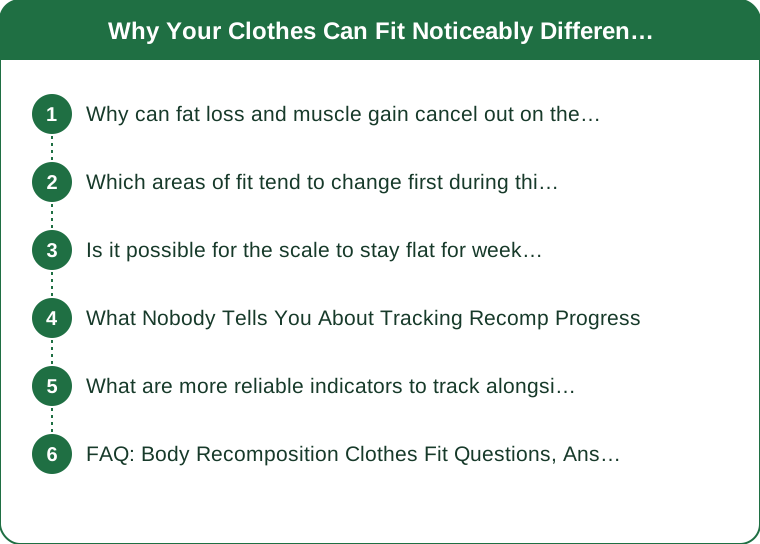
Why can fat loss and muscle gain cancel out on the scale but not in a mirror?
Muscle tissue is denser than fat tissue, meaning a pound of muscle takes up meaningfully less physical space than a pound of fat — so if someone loses roughly a pound of fat while gaining roughly a pound of muscle, total weight stays the same, but the body has genuinely become more compact and differently shaped in that same weight, which is exactly what changes how clothing fits.
Which areas of fit tend to change first during this kind of recomposition?
Waistbands, the fit through the hips and thighs on pants, and how a fitted top sits through the midsection tend to show change earliest, since these are areas where fat loss is often visually meaningful even in small amounts, while muscle gain in the glutes, thighs, and shoulders can simultaneously change how looser garments drape.
Is it possible for the scale to stay flat for weeks while this is happening?
Yes, and it’s actually a common pattern during a well-executed recomposition phase — weekly weight can fluctuate within a narrow, flat-looking range for a month or more while underlying composition is shifting meaningfully, which is precisely why relying on the scale alone during this phase often reads as ‘nothing is working’ when quite a lot is.

What Nobody Tells You About Tracking Recomp Progress
Most people are told to track weight and are quietly disappointed when it doesn’t move, without ever being told that a flat scale during a genuine recomposition phase is not a failure signal — it can be exactly what successful recomposition looks like in the short term. The layer almost nobody mentions is that this flat-scale period can last considerably longer than people expect, sometimes six to eight weeks, before the scale starts trending in either direction, which means giving up on the process specifically because of the scale is often giving up right before it would have shown up elsewhere first.
What are more reliable indicators to track alongside or instead of scale weight?
Waist circumference measured consistently, how a specific pair of well-fitted pants feels, progress photos taken under consistent lighting and pose, and strength progression in the gym all tend to move more reliably during recomposition than scale weight alone, since they’re capturing shape and composition rather than a single total-mass number.
FAQ: Body Recomposition Clothes Fit Questions, Answered
How long should someone expect the scale to stay flat during a real recomp phase?
Anywhere from a few weeks to two months is common, depending on training consistency and nutrition precision, though individual variation is significant and some people see scale movement sooner.
Does this pattern mean the scale is useless during recomposition?
Not entirely useless, but it should be treated as one data point among several rather than the primary measure, since on its own it can genuinely mislead during this specific phase.
Is there a way to tell recomposition apart from just imagining fit changes?
A consistent measurement routine (same tape measure spot, same time of day, same pair of reference pants) removes most of the guesswork and gives an objective comparison point beyond how something feels on a given day.
TL;DR:
- Muscle is denser than fat, so similar amounts of fat loss and muscle gain can cancel out on the scale
- Waistbands and fitted clothing areas often show change before the scale does
- A flat scale for weeks during recomposition is a common, expected pattern — not a failure sign
- Waist measurements, photos, and strength progress are more reliable recomp indicators than weight alone
- Consistent measurement habits remove the guesswork from noticing real change
When the scale stalls but the waistband doesn’t lie, the waistband is usually the more honest number.
Keep Reading
This article is for general informational and styling purposes only. Fit, sizing, and product availability may vary.