Why Body Recomposition Stalls at Week Ten
Quick Answer: Recomposition stalls around week 8 to 12 because the two easiest drivers — newbie neural gains and the initial calorie deficit — both run out at roughly the same time. Your maintenance calories also drop as you eat less and move less unconsciously. The fix is not more restriction; it is shifting to phases: a period of slight surplus focused on progressive overload, then a period of modest deficit, rather than trying to do both simultaneously forever.
Weeks one to eight were remarkable. Clothes fit differently, lifts went up, the scale barely moved and that was exactly what you wanted.
Week eleven, nothing has changed for three weeks.
This is the most predictable point in the entire process.

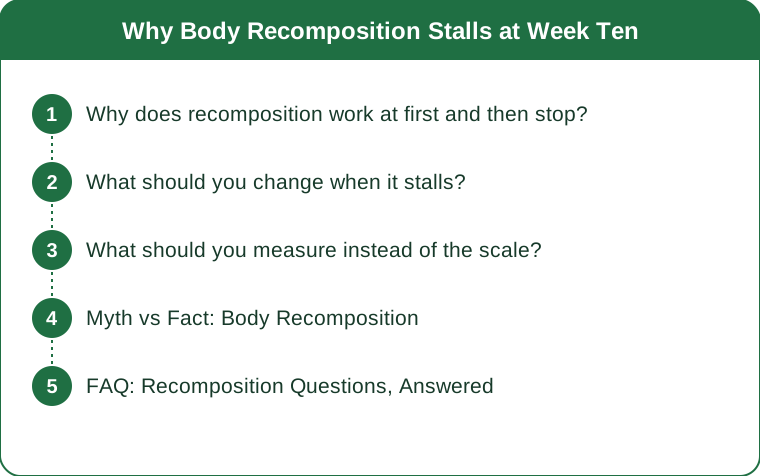
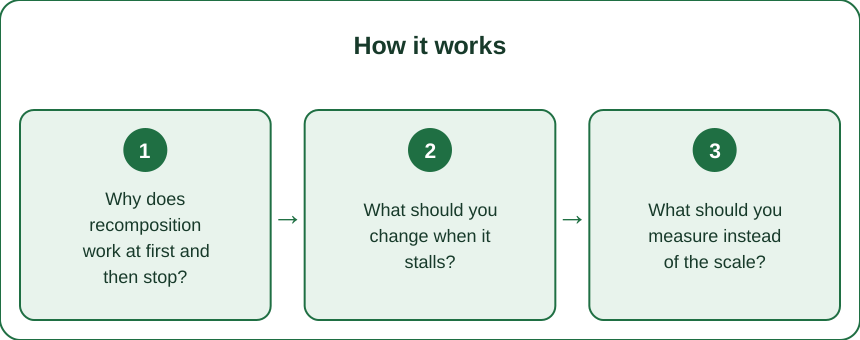
Why does recomposition work at first and then stop?
Because it depends on advantages that are temporary by nature.
Newbie gains are front-loaded. Untrained or detrained people build muscle and lose fat simultaneously far more readily. That window is genuinely limited — typically the first three to six months.
The initial deficit was larger than you think. Early changes in diet cut more calories than intended, and that gap narrows as habits settle.
Maintenance calories fall. Losing weight reduces energy requirements, and non-exercise activity drops unconsciously in a deficit — sometimes by a few hundred calories daily.
Training stops being novel. The same programme that drove adaptation in week two is maintenance by week ten.
Recovery capacity limits progress in a deficit. Building muscle while under-fuelled is possible but slow, and it gets slower as the deficit accumulates.
And measurement stops being sensitive. Recomposition changes body composition without changing weight, so the scale — the thing most people check — is the least informative measure available.
What should you change when it stalls?
Stop trying to do both jobs at once and start alternating.
Move to phases. Eight to twelve weeks at maintenance or a slight surplus with hard progressive training, then eight to twelve weeks at a modest deficit while maintaining training intensity.
A slight surplus is small. Around 5 to 10 percent above maintenance — roughly 150 to 250 calories. Larger surpluses add fat without adding muscle any faster.
Protect protein in both phases. 1.6 to 2.2g per kg throughout, and toward the top of that range in the deficit.
Change the training stimulus. Different rep ranges, new exercises, added sets. If the programme has not changed in ten weeks, that alone explains part of the stall.
Track lifts, not weight. In a recomposition, progressive overload is the actual evidence that muscle is being built. The scale is a poor witness.
Re-measure with a tape and photos monthly. Waist, hips, thigh, arm. These catch what the scale hides, and they catch it early.

What should you measure instead of the scale?
Four measures that actually reflect what is happening.
Waist circumference is the best single number. It correlates with fat mass more directly than weight and it moves in a recomposition when the scale does not.
Strength progression at fixed bodyweight. Adding reps or load without gaining weight is the clearest evidence of composition change available outside a lab.
Photographs in fixed conditions. Same light, same time of day, same posture, monthly. Change that is invisible day to day is obvious across two months.
How clothes fit at specific points. Waistbands and upper arms are the earliest indicators.
Ignore body fat scales. Bioimpedance devices vary substantially with hydration and can show swings that have nothing to do with actual composition.
Seasonal note: as autumn arrives, daily step counts typically drop noticeably without anyone deciding to. If a stall coincides with the season changing, check your step count before changing your diet — it is very often the whole explanation.
This is general information, not medical advice.
Myth vs Fact: Body Recomposition
Myth: you cannot build muscle and lose fat at the same time. Fact: you can, particularly if you are new to training, returning after a break, or carrying more body fat. It is simply slower than doing either alone.
Myth: the scale should stay exactly the same. Fact: it fluctuates by a kilogram or more daily from fluid and food volume alone. Weekly averages are the only useful reading.
Myth: a bigger deficit accelerates it. Fact: a large deficit compromises training quality and recovery, which is exactly what building muscle requires. It converts a recomposition into a simple fat loss phase.
Myth: cardio ruins recomposition. Fact: moderate cardio supports it by increasing energy expenditure and improving recovery. Excessive cardio in a deficit is the problem, not cardio itself.
Myth: you need to eat every three hours. Fact: meal frequency matters far less than total intake and protein distribution across three or four meals.
Myth: if the scale is not moving, nothing is happening. Fact: an unchanged scale during a successful recomposition is exactly the expected result. This is the single most demoralising misunderstanding in the whole process.
FAQ: Recomposition Questions, Answered
How long should each phase last?
Eight to twelve weeks. Shorter than eight and adaptations do not accumulate; longer than twelve and diminishing returns set in.
How much muscle can I realistically build in a year?
For a trained woman, roughly 2 to 4kg per year under good conditions, and less in a deficit. Slow, but it compounds.
Should I eat more on training days?
Calorie cycling — slightly more on training days, less on rest days — works well for some people and is unnecessary complexity for others. Total across the week is what matters.
Is it too late to recomp if I have trained for years?
Recomposition is slower for well-trained people but still happens, particularly after a layoff or when protein intake improves.
Why did my weight go up when I started lifting?
Muscle glycogen binds water, so new training raises weight by 1 to 2kg in the first weeks. It is not fat.
Do I need to count calories?
Not forever, but tracking for two weeks tells you where you actually are. Most people are surprised in one direction or the other.
TL;DR:
- Recomposition stalls at week 8 to 12 because newbie gains and the initial deficit both expire around then.
- Switch from doing both at once to alternating phases: 8 to 12 weeks slight surplus, then modest deficit.
- A useful surplus is only 5 to 10 percent above maintenance — bigger adds fat, not muscle.
- Track waist, strength and photos, not the scale. An unchanged scale is the expected result.
- Autumn step-count drops explain more stalls than diet does. Check that first.
Measure your waist and log your top set this week. Those two numbers tell you more than a month of weighing yourself.
Keep Reading
This article is for general informational and styling purposes only. Fit, sizing, and product availability may vary.