Why Body Recomposition Stalls Around Month Three
Quick Answer: Month three is when three things converge: newbie gains taper, your maintenance calorie needs have shifted as your body composition changed, and your training has stopped being novel enough to drive adaptation. It is not a metabolic failure. Recalculating intake, adding progressive overload, and switching your tracking metrics from the scale to strength and measurements restarts progress within a few weeks.
Weeks one through eight were genuinely exciting. Strength climbing, clothes fitting differently, visible change. Then week ten arrives and nothing has moved for a fortnight.
This is not you doing it wrong. Three separate timelines happen to reach their end around the same point, and each has a specific fix.
Here is what stalled and what to change.

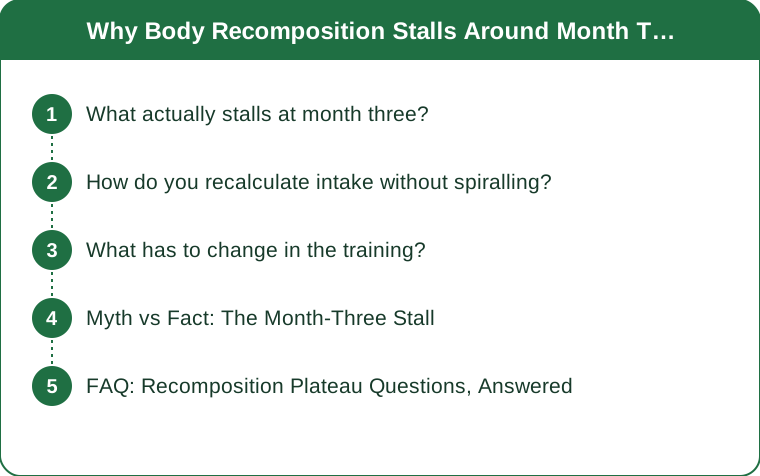
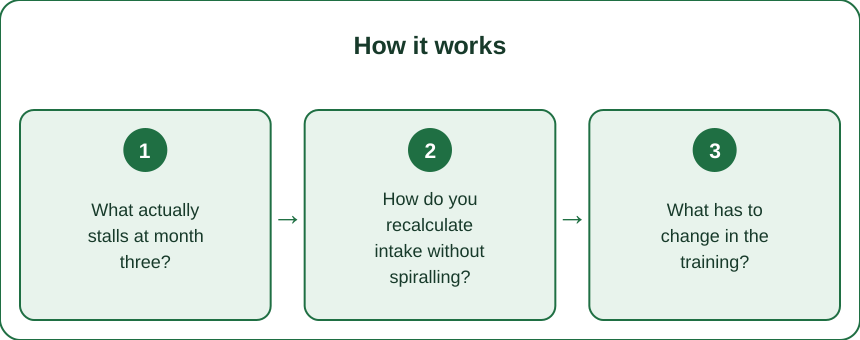
What actually stalls at month three?
Three things, all at once, which is why the stall feels so abrupt.
Early adaptation runs out. The first two months of resistance training produce large strength gains from neural learning — better recruitment and coordination — rather than new muscle. That well runs dry around weeks 8 to 12, and further strength gains now require actual tissue change, which is slower.
Your maintenance calories have moved. If you have lost fat, you carry less mass and expend less energy moving it. The intake that produced a small deficit in week one may be maintenance by week twelve. Nothing broke — the arithmetic changed underneath you.
Your training stopped being a challenge. Doing the same sets and reps with the same weight is, by definition, no longer a progressive stimulus. Many people hold their program constant for three months without noticing they stopped adding load after week five.
And your tracking may be hiding progress. Recomposition means losing fat and gaining muscle simultaneously, which can leave weight completely unchanged for months while your body genuinely changes. A flat scale during recomp is often success being measured badly.
How do you recalculate intake without spiralling?
One adjustment, then wait three weeks. Resist making four changes at once.
Recalculate from your current weight, not your starting weight. Use your actual current body weight in whatever formula you started with. Most people find their target has dropped by 100 to 200 calories.
Adjust by a small amount. A 150 to 200 calorie change is enough. Large cuts during recomp cost lean mass, which is the opposite of the goal.
Protect protein. Keep protein at 1.6 to 2.2 g per kg of body weight. If you are reducing calories, take it from fat or carbohydrate, not protein.
Then hold for three weeks before judging. Weekly weight fluctuates by several pounds from water, sodium, glycogen, and cycle phase. Two weeks of data during recomp is noise; four weeks is a trend.
Or consider going the other way. If you have been in a deficit for three months, a period at genuine maintenance with hard training is frequently what unlocks visible recomposition. It is counterintuitive and it works.

What has to change in the training?
Progressive overload, applied deliberately rather than hopefully.
Add load or reps every week on your main lifts. Even 2.5 lb or one extra rep. If your logbook shows the same numbers for a month, that is your stall in writing.
Increase volume modestly. Going from 10 to 14 hard sets per muscle group per week is a common and effective step at this stage. More is not indefinitely better; this is a step, not a direction.
Push closer to failure. Many people plateau because their sets are 4 or 5 reps short of failure. Working to within 1 to 2 reps of failure on your last set of each exercise is often the whole missing stimulus.
Change exercises, not the entire program. Swap a barbell variation for a dumbbell one, or change grip and stance. Novel stimulus with the same structure preserves the progression you have built.
Keep the frequency. Twice weekly per muscle group beats once weekly for both strength and hypertrophy. If you are on a once-a-week split, this is the highest-value change available.
Myth vs Fact: The Month-Three Stall
Myth: Your metabolism has adapted and broken. Fact: metabolic adaptation is real but modest — typically a small percentage, not the several-hundred-calorie collapse people imagine. The larger factor is simply that you weigh less.
Myth: You need a diet break. Fact: a period at maintenance can help, particularly psychologically and hormonally after a long deficit. But it is one option, not a required step, and it does not fix a training program that stopped progressing.
Myth: Recomp stops working after a few months. Fact: recomposition continues for years in trained people, just more slowly. What changes is the rate, and the need to measure it properly.
Myth: You should cut hard to break the plateau. Fact: aggressive cuts during recomp cost lean mass and often make the visual outcome worse. Small adjustments and better training beat large cuts almost every time.
Myth: The scale is the honest metric. Fact: during recomposition, the scale is the least informative number you have. Waist measurement, strength numbers, and progress photos in identical conditions tell you far more.
FAQ: Recomposition Plateau Questions, Answered
How do I know if I am actually stalled or just measuring badly?
Check four things over four weeks: waist measurement, total volume lifted on two main lifts, how a specific pair of trousers fits, and progress photos in the same light and position. If all four are flat, you are stalled. If any is moving, you are not.
Should I switch to a bulk or a cut instead?
If you are relatively new to training, staying at maintenance with hard progressive training is usually the best value — recomp is genuinely available to you. If you are more advanced, dedicated periods of surplus and deficit become more efficient than trying to do both at once.
How long before I should expect progress again?
With intake recalculated and real progressive overload restored, most people see measurable change within three to four weeks. If six weeks pass with nothing moving on any of the four metrics above, the training volume or the intake estimate is the place to look again.
This is general information, not individual medical or nutrition advice.
TL;DR:
- Month three is where newbie neural gains taper, your maintenance calories shift downward, and your training stops being progressive.
- Recalculate intake from your current weight, adjust by only 150 to 200 calories, and keep protein at 1.6 to 2.2 g/kg.
- Hold any change for three to four weeks before judging — two weeks of scale data during recomp is noise.
- Restore progressive overload: add load or reps weekly, step volume to around 14 hard sets per muscle group, train within 1 to 2 reps of failure, train each group twice weekly.
- Track waist, strength volume, clothing fit, and standardized photos — not the scale.
- A period at genuine maintenance often unlocks visible recomposition after a long deficit.
The month-three stall feels like a wall and is really a scheduled handover: from the easy adaptations to the ones that require deliberate progression. Change the arithmetic and the overload, and it resolves in about a month.
Keep Reading
This article is for general informational and styling purposes only. Fit, sizing, and product availability may vary.