Why the Scale Can Stall Even When Body Recomposition Is Actually Working
Quick Answer: During true body recomposition — losing fat while gaining muscle simultaneously — the scale can stay flat for weeks even as your body composition visibly improves, because muscle gain is quietly offsetting fat loss in the total number.
You’re eating well, training consistently, and your clothes fit differently — but the scale hasn’t budged in a month. That’s not necessarily a stall.

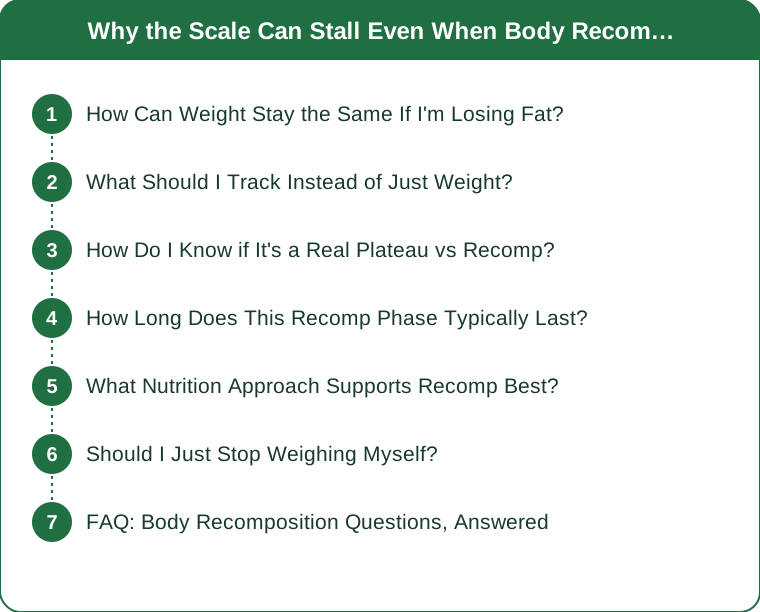
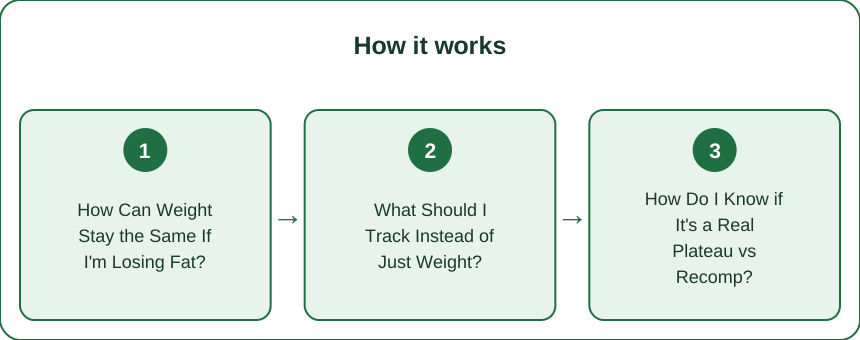
How Can Weight Stay the Same If I’m Losing Fat?
Muscle tissue is denser than fat tissue, so gaining a pound of muscle while losing a pound of fat leaves the scale number unchanged while your body composition genuinely improves. This is most pronounced in the first several months of a structured strength program, especially for beginners or people returning after time off.
What Should I Track Instead of Just Weight?
Body measurements (waist, hips, arms) and progress photos every 2-4 weeks are far more reliable than daily scale weight during recomp. Strength progression on your main lifts is also a strong indirect signal — if your numbers are climbing, you’re very likely gaining muscle even if the scale disagrees.
How Do I Know if It’s a Real Plateau vs Recomp?
If your measurements are shrinking or your clothes fit looser while the scale stays flat, that’s recomp working as intended. A genuine plateau shows up as no change across weight, measurements, and photos together over 4+ weeks — that combination is the real signal to adjust something.

How Long Does This Recomp Phase Typically Last?
For most people new to structured training, this simultaneous fat-loss/muscle-gain phase lasts roughly 3-6 months before the two processes start to decouple — after that, most people need to choose a slight surplus or deficit to keep progressing efficiently in one direction.
What Nutrition Approach Supports Recomp Best?
Eating at roughly maintenance calories with high protein (0.8-1g per pound bodyweight) supports both goals simultaneously better than an aggressive deficit, which tends to blunt muscle gain, or a large surplus, which adds unnecessary fat alongside the muscle.
Should I Just Stop Weighing Myself?
Not necessarily — weight is still useful data over the long run, just not on a day-to-day basis. Weigh 2-3 times a week at the same time of day and look at the trend across a full month, not any single reading.
FAQ: Body Recomposition Questions, Answered
Can everyone do body recomposition, or only beginners?
Beginners and people returning after a break see it most clearly, because their muscle-building potential is highest; more advanced trainees see smaller, slower recomp effects.
How do I know if I should switch to a fat-loss phase instead?
If measurements plateau alongside the scale for a full month with no photo changes, a deliberate calorie deficit phase is usually the next step.
Is strength progress a reliable sign muscle is being built?
Yes — consistent strength gains on compound lifts are one of the more dependable indirect signs of muscle growth, even without visible or scale changes yet.
TL;DR:
- A flat scale during recomp can mean muscle gain is offsetting fat loss
- Track measurements, photos, and strength — not just scale weight
- A real plateau shows flat numbers across all three, not just the scale
- This phase typically lasts 3-6 months for people newer to training
- Eat near maintenance with high protein to support both goals at once
Keep Reading
This article is for general informational and styling purposes only. Fit, sizing, and product availability may vary.