The Scale Isn't Moving Because Recomp Is Working: How to Read Body Recomposition Progress
Quick Answer: During body recomposition — losing fat while building muscle — the scale is structurally blind: a month of losing 1kg fat and gaining 1kg muscle reads as zero. Track instead with the tools that see composition change: monthly photos (same light, pose, time of day), waist and hip measurements, how clothes fit, and gym performance. A frozen scale + shrinking waist + rising lifts is the recomp success signature, not a plateau.
Three weeks into a well-run recomp, the scale delivers its verdict: nothing. And because the scale has spent your whole life being the metric, ‘nothing’ feels like failure — right at the moment the mirror, your waistband, and your dumbbells are all quietly reporting the opposite.

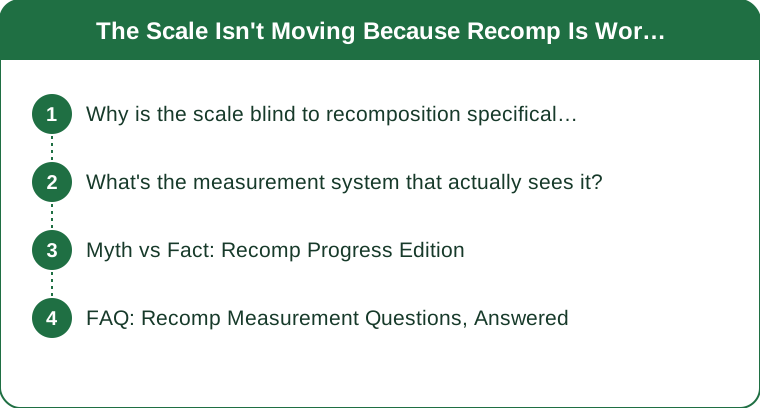
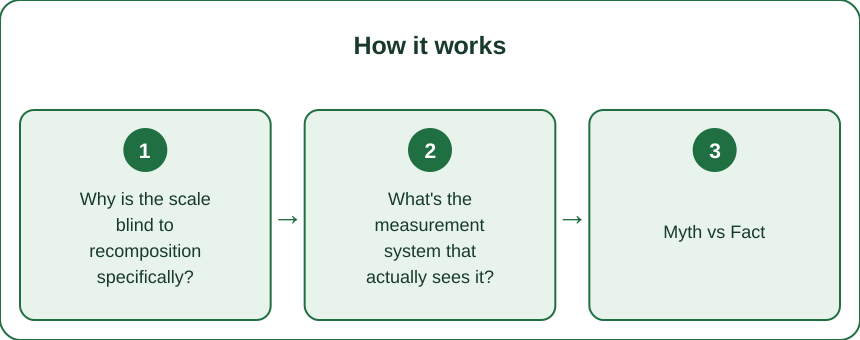
Why is the scale blind to recomposition specifically?
The scale measures total mass — one number for a two-directional process. Recomp by definition moves fat down and muscle up simultaneously, and when those changes are similar in size (they often are, especially for beginners, returners, and people with higher starting body fat — the groups recomp works best for), the net reads as zero.
The visual math makes it stranger: muscle is denser than fat — the same kilogram occupies noticeably less space as muscle. So a zero-scale month with a 1-for-1 swap means you got measurably smaller at the same weight. Clothes loosen at a frozen number, which is deeply confusing to scale-trained brains.
Add daily noise (water shifts of 1-2kg from sodium, carbs, cycle phase, and training inflammation — new lifters hold extra water in recovering muscles for weeks) and the scale isn’t just blind to recomp; it’s actively hallucinating on any given morning.
What’s the measurement system that actually sees it?
Four instruments, monthly cadence:
- Photos (the champion): front, side, back — same lighting, same time of day (morning), same minimal outfit, phone propped at the same height. Judged monthly, never daily; composition change is invisible across days and unmistakable across months.
- Tape measurements: waist at navel, hips at widest, plus optionally thigh and arm — same conditions monthly. The waist-down-scale-flat combination is the single clearest recomp signal in existence.
- The clothing jury: a specific pair of fitted jeans or a fitted skirt — how they button and sit is a composition measurement wearing a fashion costume, and it’s immune to water noise.
- Performance log: lifts going up while measurements go down closes the case — you cannot add strength for months while ‘losing muscle,’ whatever the scale implies.
The dashboard read: any two of (photos improving / waist shrinking / clothes loosening / lifts climbing) = recomp working, scale irrelevant. All four flat for 6-8 weeks = that’s an actual plateau, and the levers are protein (1.6-2.2g/kg), progressive overload honesty, and sleep — in that audit order.

Myth vs Fact: Recomp Progress Edition
Myth: Muscle weighs more than fat. Fact: A kilogram is a kilogram — muscle is denser, occupying roughly 15-20% less space per kilogram. The correct sentence is ‘muscle takes less room,’ which is exactly why recomp shrinks you at stable weight.
Myth: You can feel muscle turning into fat (or vice versa). Fact: They’re different tissues — one never becomes the other. Recomp is two separate processes (fat loss + muscle gain) running concurrently, which is also why it’s slower than either process run alone and why patience is a structural requirement, not a virtue.
Myth: Smart scales solve this — they measure body fat. Fact: Consumer bioimpedance scales are notoriously noisy (hydration swings alone move readings several percent) — useful for long multi-month trends at best, actively misleading week to week. The tape-photo-clothes-performance dashboard outperforms the gadget, for free.
The meta-myth underneath: that progress needs a daily number. Composition change is a monthly-resolution phenomenon — checking daily is measuring ocean tides with a ruler in the waves. This is general information, not medical advice.
FAQ: Recomp Measurement Questions, Answered
How long before photos show visible change?
Honest timeline: 8-12 weeks for changes you notice in photos, often sooner in measurements and clothes fit. Recomp runs on a slower clock than pure cutting — the double process is the price of the double result.
Should I ditch the scale entirely?
Optional — weekly-averaged weigh-ins (daily weights averaged across the week) stay useful as one noisy input for some people, while others do better without the number’s emotional gravity. The rule: the scale gets a vote, never the veto — and if it costs you motivation, it costs more than it measures.
My waist is shrinking but the scale went UP — what?
That’s not a problem; that’s an exceptional report card: fat down, muscle up faster — common in returning lifters (muscle memory) and beginners on good protein. File it under success and keep the tape as the tiebreaker.
TL;DR:
- Recomp moves fat down and muscle up at once — the scale nets to zero while your body visibly changes
- The dashboard: monthly photos, waist/hip tape, a fitted-clothes jury, and the performance log — any two improving = it’s working
- Muscle takes ~15-20% less space per kg: smaller at the same weight is the whole point
- Real plateau = all four flat for 6-8 weeks → audit protein, progressive overload, sleep
The scale wasn’t reporting failure — it was reporting a tie in a game where ties mean you’re winning. This is general information, not medical advice.
Keep Reading
This article is for general informational and styling purposes only. Fit, sizing, and product availability may vary.