Progress Photos That Actually Show Progress: The Protocol
Quick Answer: Take photos monthly, in the morning before eating, in the same spot with the same natural light, in the same fitted outfit, from three angles — front, side, back — with a relaxed posture and no flexing. Then only compare shots that are at least two months apart. Adjacent months whisper; quarters speak.
Body recomposition plays a cruel trick: you lose fat and gain muscle at roughly similar rates, so the scale sits there doing absolutely nothing for eight weeks while your body quietly reorganizes itself.
The mirror is no better — you see yourself every day, so change below the noise threshold is invisible.
Progress photos are the one reliable witness. But only if you take them correctly, and “correctly” is doing all the work in that sentence.


Why do most progress photos fail?
Because variance drowns the signal. Every uncontrolled variable adds noise bigger than the actual change you’re trying to see.
Lighting is the biggest distorter by a wide margin. Overhead bathroom light casts shadows that read as definition. Soft window light flattens everything. Take one photo under each and you’ll have documented a dramatic transformation that never happened — in either direction.
Time of day is second. Morning, fasted, is a genuinely different body than 8pm after dinner. Food volume, water retention, and bloating easily create a 2–3 cm waist difference within a single day. Compare a morning photo to an evening photo and you’re measuring digestion.
Pose is third. Small changes in hip position, shoulder rotation, and whether you’re subtly bracing your abs change the silhouette more than two months of training will.
Lock those three and the photos stop being selfies and become instruments.
What’s the actual protocol?
Ninety seconds, once a month. Same approximate date each time.
- Morning, before eating or drinking much, after using the bathroom. Non-negotiable — this is the most standardized your body gets all day.
- Same spot, same window. Pick a wall with consistent natural light and no direct sun. Mark the floor with tape where you stand. This sounds obsessive; it’s the difference between usable and useless data.
- Phone at the same height, propped on the same surface. Roughly chest height, level, about 2 meters away. Mark that spot too.
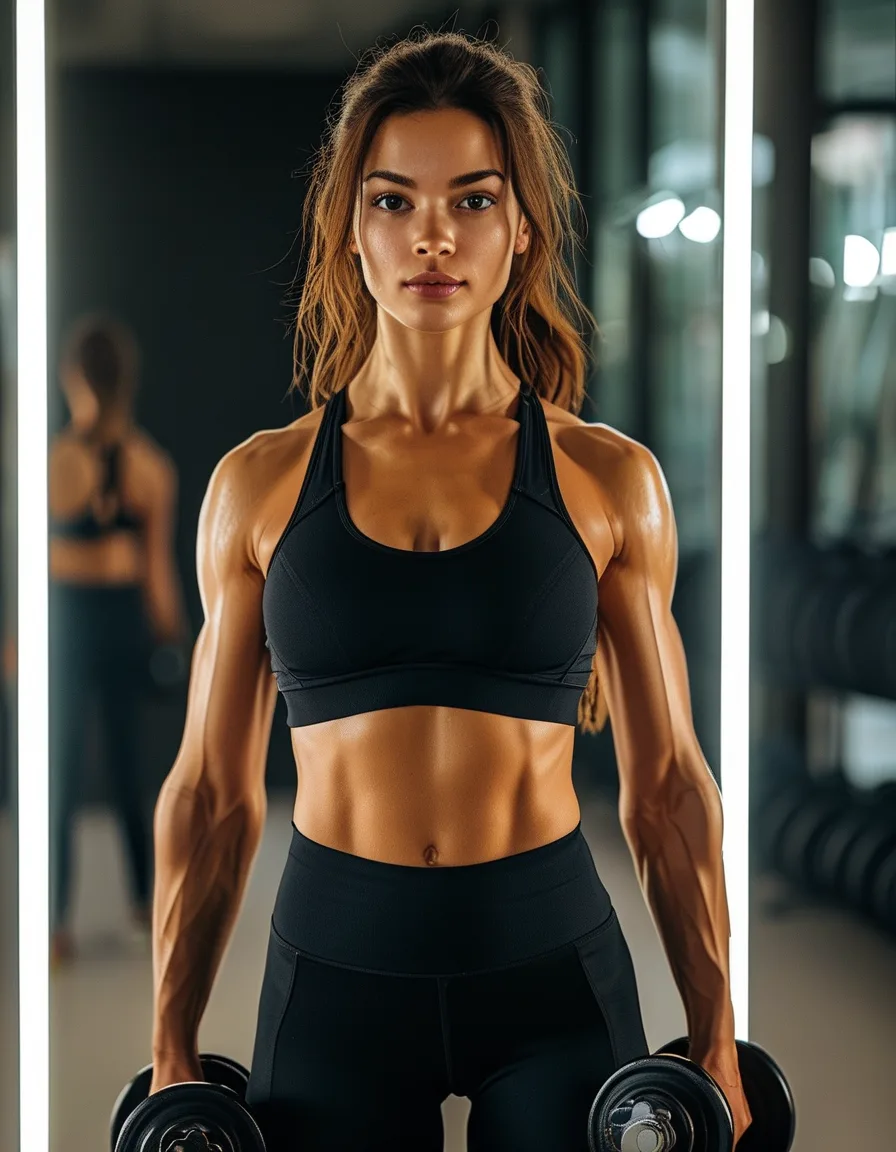
- Same fitted outfit every time — sports bra and shorts, or fitted underwear. Loose clothing hides exactly what you’re trying to see.
- Three angles: front, side, back. The side view is where recomposition shows up first, and it’s the one people skip.
- Neutral posture, no flexing. Arms relaxed at your sides, normal breathing, normal stance. The relaxed body is the data. A flexed comparison photo only tells you that you got better at flexing.
- Archive with the date in the filename in a folder you won’t scroll past accidentally.
How often should I compare them?
At two-month gaps minimum, and ideally quarterly.
This is the rule people break most often and it’s the one that causes the most discouragement. Month one versus month two shows you nothing but noise — hydration, sleep, sodium, and where you are in your cycle all move the needle more than four weeks of training does.
Month one versus month four is where recomposition holds a press conference. That’s the comparison where the scale said nothing for 16 weeks and the side view shows a completely different waist-to-shoulder relationship.
Practical approach: take them monthly, review them quarterly. Take the photo, file it, close the folder. The discipline is in not looking.

What Nobody Tells You
Your day-one photo becomes valuable exactly when it stops being embarrassing. Everyone wants to delete it in month one. Nobody who kept it regrets it in month twelve. Take it, file it, don’t look at it.
Photos aren’t the only instrument, and for some people they’re the wrong one. If reviewing them sends you into a spiral rather than informing a decision, stop. Tape measurements at four sites (waist, hips, thigh, upper arm), how your clothes fit, and a strength log carry essentially the same information with completely different emotional packaging. The tracking exists to serve you, and if it doesn’t, it goes.
Menstrual cycle timing matters more than most protocols admit. Water retention in the luteal phase can add 1–2 kg and visible bloating. If you cycle, take photos at the same phase each month — day 5–10 is usually the most consistent window.
Take them clinically. Camera, three shots, done, phone away. This isn’t a mirror session, and the review is a separate event scheduled months later.
FAQ
How often should you take progress photos?
Monthly is the sweet spot — frequent enough to build a record, infrequent enough that each shot contains real change. Weekly photos mostly capture water weight and digestion, which tends to produce discouragement rather than information.
Why don’t my progress photos show any change?
Usually because you’re comparing photos taken too close together, or the conditions varied between them. Recomposition typically needs 8–12 weeks to become visible. Check that lighting, time of day, clothing, and pose were consistent — if any of those changed, you’re comparing conditions rather than bodies.
Should I flex in progress photos?
No — take them relaxed. A flexed photo measures your flexing skill as much as your body, and that skill improves quickly, which fakes progress. If you want both, take a relaxed set as your data and a flexed set separately for fun, but only ever compare like with like.
TL;DR:
- Same light, same time of day, same spot, same outfit, same pose — variance is what kills progress photos.
- Morning, fasted, three angles including the side view, relaxed with no flexing.
- Mark the floor and the phone position. It’s not excessive; it’s the whole point.
- Take monthly, compare quarterly. Adjacent months are noise.
- If photos distress rather than inform, use measurements and a strength log instead — same data, different packaging.
Keep Reading
This article is for general informational and styling purposes only. Fit, sizing, and product availability may vary.