How to Tell Recomp Is Working When the Scale Refuses to Move
Quick Answer: Recomposition means gaining muscle while losing fat, and since the two changes push body weight in opposite directions, a flat scale is the expected signature of success — not evidence of failure. The signals that actually move are the tape measure at the waist and hips, monthly photos taken under identical conditions, your strength log, and how specific clothes fit. Check those on a six-to-eight-week evaluation window, and demote the scale to a supporting data point at most.
Most abandoned recomps were working. They were just being measured with the one tool designed to miss it.

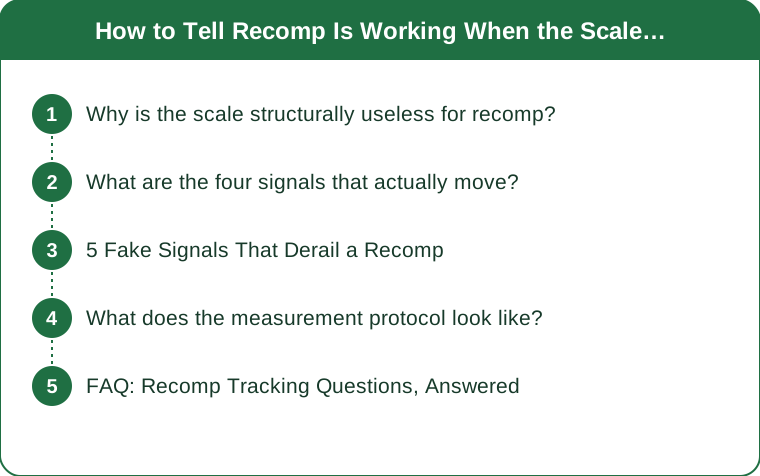
Why is the scale structurally useless for recomp?
Because it reports the sum of two numbers you are deliberately moving in opposite directions.
A successful recomp month might trade a pound and a half of fat for a pound and a half of muscle. Scale change: zero. The same scale reading also covers a failed month where nothing happened at all. The instrument literally cannot distinguish your best case from your worst case — that is not a noisy signal, it is no signal.
Then the noise arrives on top. Day-to-day weight swings of two to four pounds from water, glycogen, sodium, cycle phase, and digestive contents dwarf the near-zero trend you are looking for. New training itself adds water: muscles storing more glycogen and the mild swelling of hard sessions both nudge weight up in exactly the weeks fat is leaving.
The psychology completes the damage. A flat line reads as nothing is happening to a brain trained by diet culture to expect weight loss as the receipt for effort. So people respond by cutting calories harder — converting a working recomp into an under-fueled cut that stalls the muscle half of the project — or by quitting entirely, six weeks into a process that was quietly succeeding.
If you keep weighing, keep it honest: same time, same conditions, weekly average rather than daily readings, and treated strictly as one minor input. Better yet, let the tools below carry the verdict and let the scale go dark for a month. Nothing about recomp lives there.
What are the four signals that actually move?
Each one tracks a different half of the trade, and together they triangulate what the scale cannot see.
The tape measure is the fat-loss detector. Waist at the navel and hips at the widest point, plus any site you personally care about. Fat leaving the trunk shows up in tenths of inches at the waist even while weight holds — a half inch off the waist over eight weeks at stable weight is a textbook recomp receipt.
Photos are the shape detector. Monthly, not weekly — shape change is too slow for weekly eyes, which is precisely why the mirror gaslights you. Same spot, same time of day, same lighting, same fitted leggings and sports bra, front-side-back, phone propped rather than handheld. The comparison at week eight tells you things no number does: shoulders appearing, waist-to-hip contrast sharpening, legs carrying visible shape.
The strength log is the muscle detector. Muscle you are gaining shows up as reps and load you could not produce before. If your rows, squats, and presses are trending up across a two-month window while the waist tape trends down, fat is leaving and tissue is arriving — that combination has no other explanation.
Clothes are the ambient detector. The waistband of a specific pair of jeans going loose while the thighs fill the same leggings differently is data collected passively, all day, by the most consistent instruments you own. Pick two reference garments and notice them on purpose.
None of these is impressive alone. The pattern across all four is unmistakable.

5 Fake Signals That Derail a Recomp
The daily scale check. Covered above, but it earns first place because it is the one that ends the most recomps. A number that cannot detect success gets consulted every morning and believed every time.
The post-workout mirror. The transient fullness after training — extra blood and fluid in worked muscles — is real and temporary. Judging progress from the flattering ten minutes after a session, or despairing at the flat look of a rest morning, is measuring hydration theater. Photos exist to replace exactly this.
The one-off skinny day. Low-carb day plus a hard sweat plus an empty stomach produces a lean-looking morning that means nothing. Its evil twin — the bloated day after a salty restaurant dinner — means equally nothing. Single days are weather; eight-week windows are climate.
Smart-scale body-fat percentage. Bioimpedance readings swing multiple percentage points with hydration, food timing, and foot placement, and their absolute accuracy on any given body is poor. As a daily trend tool for a process measured in half-percent changes, it is noise wearing a decimal point.
Someone else’s timeline. Recomp speed varies enormously with training age, genetics, sleep, and starting point — beginners and returners recomp dramatically faster than trained lifters, and lean people recomp slower than people with more fat to trade. A stranger’s twelve-week transformation is their data, not your deadline.
The common thread: every fake signal is faster and louder than the real ones. Recomp asks you to trust slow, quiet instruments over fast, noisy ones — which is the actual skill.
What does the measurement protocol look like?
A calendar, controlled conditions, and pre-decided rules for interpreting the results.
Cadence: tape every two weeks, photos every four, strength logged every session, scale weekly-average at most and optional. More frequent measurement adds noise, not information — the changes are too slow to survive daily inspection.
Conditions: always morning, before food and after the bathroom, tape snug but not compressing, same anatomical landmarks — navel is a landmark, wherever my waistband sat is not. Photos in the same fitted clothes; a garment change between photo sessions quietly invalidates the comparison your eyes will try to make.
What success looks like at week eight: some combination of waist tape down a quarter to a full inch, visible photo differences at the shoulders, waist, or legs, and strength up on your main lifts. Any two of the three is a working recomp. All three is a textbook one.
What a true stall looks like: twelve weeks with flat tape, identical photos, and a strength log that stopped climbing. That is not a verdict on you — it is an audit trigger for the inputs: protein actually totaled rather than estimated, sleep hours counted honestly, training carrying progressive overload rather than repetition, and calories not drifted into an accidental deep deficit. One of those four is nearly always the answer, and sleep is the most common culprit of the quiet ones.
Run the protocol and the flat scale transforms from a daily verdict into what it always was during recomp: the least interesting number in the notebook.
This is general fitness information, not medical advice — sustained appetite loss, exhaustion, or cycle disruption during body-change efforts deserve professional eyes.
FAQ: Recomp Tracking Questions, Answered
What is the best time of day to measure?
First thing in the morning, every time — post-bathroom, pre-food, pre-workout. Consistency of conditions matters more than the conditions themselves; an afternoon measurement routine done identically would also work, but mornings are the easiest slot to standardize.
Do I need to eat at maintenance calories for recomp?
Recomp conventionally lives around maintenance or a small deficit with high protein and progressive training doing the heavy lifting. The measurement system is how you personalize it: strength climbing and waist shrinking means your current intake is working, whatever the calculator claimed.
Can recomposition go on for years?
The rapid version belongs to beginners, returners after a break, and those with more fat to trade — for them, months of simultaneous progress is normal. Advanced lean lifters see it slow toward imperceptible, at which point dedicated gain and loss phases become the efficient tool. The tracking protocol is identical either way; only the expected rate changes.
Is a smart scale’s body-fat trend useful if I ignore the absolute number?
Marginally, over months, under rigidly identical conditions — but its noise floor is close to the entire effect you are hunting. The tape, photos, and strength log answer the same question with better instruments. If the smart scale stays, treat its percentage like horoscope content: occasionally interesting, never load-bearing.
TL;DR:
- Recomp moves fat and muscle in opposite directions, so a flat scale is the expected signature of success — and cannot distinguish your best month from your worst.
- The real detectors: waist-hip tape biweekly, identical-condition photos monthly, a strength log every session, and two reference garments.
- Ignore the fake signals — daily weigh-ins, post-workout mirrors, skinny days, smart-scale percentages, and other people’s timelines.
- Evaluate at eight weeks; audit protein, sleep, overload, and calories only after twelve flat weeks across all instruments.
Set up the system tonight: tape numbers in your phone, first photo set taken, reference jeans chosen. Eight weeks from now you will have an answer instead of a feeling.
See It in Motion
Seen here: High Waist Yoga Leggings with Side Pockets — shop it on bubblelime.com
Keep Reading
This article is for general informational and styling purposes only. Fit, sizing, and product availability may vary.