Why the Scale Won't Move Even When Recomposition Is Working
Quick Answer: During body recomposition you’re often losing roughly a pound of fat while gaining roughly a pound of muscle in the same week, which cancels out on the scale entirely — the scale isn’t broken, it’s just measuring total mass, not composition, and composition is the whole point of what you’re doing.
Six weeks of consistent training and eating, and the scale says the same number it said on day one. That’s not a stall — read the room a little further.

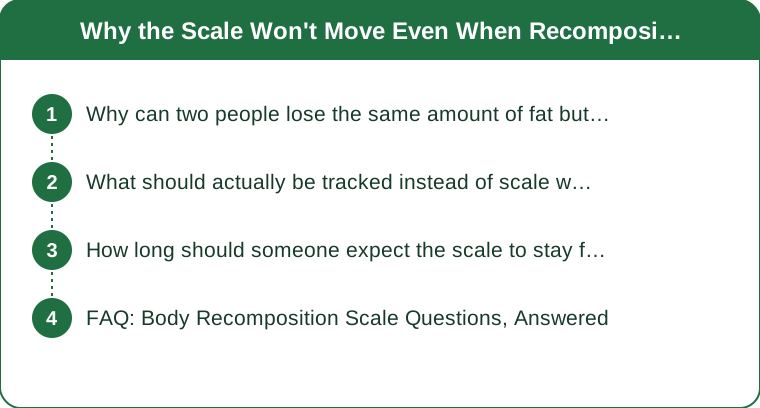
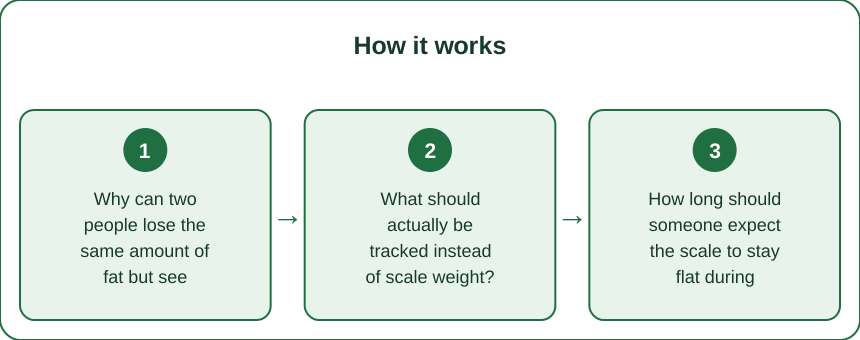
Why can two people lose the same amount of fat but see totally different scale results?
Someone new to strength training can build muscle fast enough to offset fat loss almost pound for pound, especially in the first few months of consistent training. Someone with years of lifting experience builds muscle much more slowly, so their fat loss shows up more clearly on the scale. Recomposition speed depends heavily on training age, which is why scale behavior varies so much between people doing the exact same program.
What should actually be tracked instead of scale weight?
Progress photos in consistent lighting/pose every 2 weeks, a tape measure at waist/hip/arm, and how clothes fit are all more honest signals during recomposition than the scale. Some people also use a simple strength log — if your lifts are going up while your weight stays flat, that’s strong indirect evidence you’re building muscle, not just plateauing.

How long should someone expect the scale to stay flat during genuine recomposition?
Anywhere from 6-16 weeks is normal before the scale starts trending in either direction, depending on training experience and how closely fat loss and muscle gain are matched during that window. Beginners often see the longest flat stretches precisely because their muscle-building rate is highest.
FAQ: Body Recomposition Scale Questions, Answered
Should I stop weighing myself during a recomp phase?
Not necessarily — weighing weekly still catches genuine problems (like under-eating causing muscle loss too), but the number should be one data point among several, not the deciding one.
Is it possible the scale isn’t moving because nothing is actually happening?
It’s possible, which is why photos and measurements matter — if those are also flat after 8+ weeks with consistent training and eating, that’s a better signal to reassess than scale weight alone would be.
Does recomposition ever show up on the scale eventually?
Yes — once fat loss outpaces the (naturally slowing) rate of muscle gain, typically past the initial beginner phase, the scale usually starts trending down even while strength keeps climbing.
TL;DR:
- A flat scale during recomposition often means fat loss and muscle gain are canceling out, not that nothing’s happening
- Beginners see the longest flat stretches because their muscle-gain rate is highest
- Photos, measurements, and strength logs are more honest recomp trackers than scale weight
- A flat scale for 6-16 weeks alongside strength gains is a normal, expected pattern
The scale answers “how much do you weigh,” not “what are you made of” — recomposition is a question about the second one.
Keep Reading
This article is for general informational and styling purposes only. Fit, sizing, and product availability may vary.