Body Recomposition for Women: What Do the First 12 Weeks Actually Look Like?
Quick Answer: In the first twelve weeks of a well-run recomposition, expect strength to climb from around week two, clothes to fit differently between weeks six and ten, and scale weight to move very little or not at all throughout. The changes arrive in that order, and the middle stretch where the scale is flat and the mirror is ambiguous is the normal experience, not a stall.
Most recomposition content describes the mechanism.
This describes the twelve weeks, because knowing what week seven feels like is what gets people to week twelve.
This is general information, not medical advice.

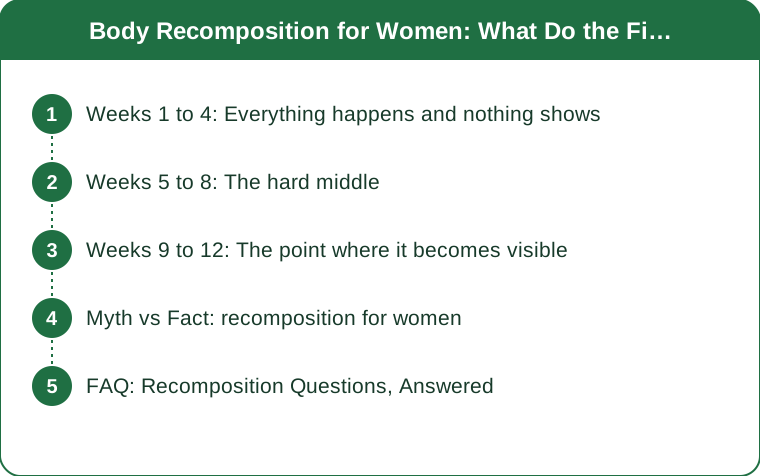
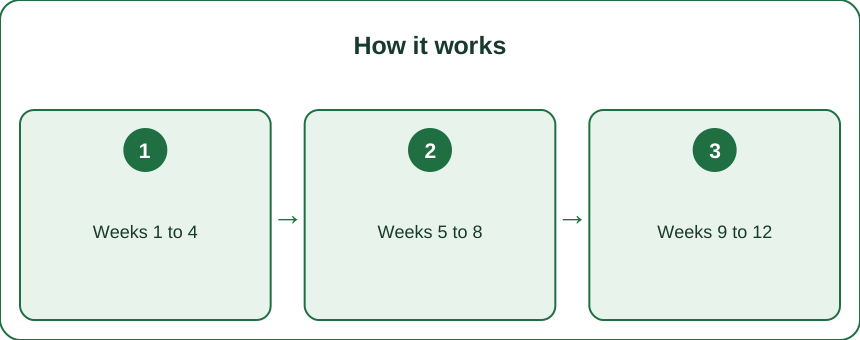
Weeks 1 to 4: Everything happens and nothing shows
The first month is where the most important changes are the least visible.
What is actually happening: your nervous system is learning the lifts. Early strength gains are largely neural — better recruitment, better coordination, better technique — rather than new muscle tissue. This is why beginners add weight quickly and why that rate does not continue.
What you will notice:
- Strength climbing from around week two. Often noticeably. This is the most reliable early signal and the one worth anchoring to.
- Soreness that reduces after the first two weeks as your body adapts to the movements.
- Scale weight possibly going up. Muscle glycogen and the water stored with it increase when you start training, and it can add a couple of pounds within the first fortnight. This is not fat gain, and it derails more recomps than anything else at this stage.
- No visible change. Correct and expected.
What matters most in this phase: hitting protein consistently — commonly 1.6 to 2.2 g per kg of bodyweight for people training seriously — and eating at roughly maintenance rather than in a deficit. Recomposition needs enough energy to build with.
Should I be weighing myself?
If it will not upset you, weekly averages are more useful than daily numbers. If the scale is a source of stress, measurements and photos are entirely sufficient for this process.
Weeks 5 to 8: The hard middle
This is where most people quit, and the reason is entirely predictable.
What is happening: actual muscle protein accretion is underway, and it is slow. Realistic rates for women training well are commonly cited around 0.25 to 0.5 lb of muscle per month, and often less for those past the beginner stage. Simultaneously, a small amount of fat is coming off. The two roughly cancel on the scale.
What you will notice:
- Scale weight flat. Frequently for the entire month. This is what recomposition looks like when it is working, which is genuinely difficult to believe while it is happening.
- Strength still climbing, though more slowly than in month one. This is your evidence.
- Occasional glimpses. A photo where you look different, then three where you do not. Lighting, hydration, and time of day swamp the actual change at this stage.
- Ambiguous clothes. Some things fit slightly differently, but not enough to be sure.
What matters most in this phase: not changing the plan. The single most common recomp error is deciding at week six that it is not working and switching to a deficit — which stops the muscle building and produces weight loss that looks like progress and is not what you wanted.
How do I stay motivated with no visible feedback?
Track the things that are moving. A training log showing consistent load increases across eight weeks is objective evidence of adaptation, and it is available every session.

Weeks 9 to 12: The point where it becomes visible
This is where the accumulated change crosses the threshold of perception.
What is happening: two to three months of small changes have added up to a body composition difference large enough to see and feel, even though the scale may still be within a couple of pounds of where it started.
What you will notice:
- Clothes fitting differently, reliably rather than occasionally. Waistbands are the usual first place. This is the change most women report as the moment it became real.
- Measurements moving while weight does not — commonly the waist reducing while hips and thighs hold or increase slightly.
- Visible definition in the shoulders and arms, which tend to show change earlier than the lower body.
- Strength meaningfully above where you started. Often substantially, particularly on lower-body lifts.
What matters most in this phase: taking proper measurements and photos, because you now have something to compare against and you will want the evidence. If you did not take baseline photos in week one, take them now — twelve weeks from now you will be glad.
What if nothing has changed by week 12?
Then look at three things in order: whether protein has genuinely been at target (most people overestimate), whether training load has actually progressed or stayed the same, and whether sleep has been adequate. Recomposition is more sensitive to sleep than either cutting or bulking. A twelve-week attempt with no change usually has one of those three at fault rather than the approach itself.
Myth vs Fact: recomposition for women
Myth: Recomposition only works for beginners. Fact: It works fastest in beginners, returning trainees, and those with more body fat to lose. It still works for trained women — more slowly, and with a longer timeline before anything is visible. Slower is not the same as impossible.
Myth: Lifting heavy will make you bulky. Fact: Muscle accrual rates for women are modest, and the visible outcome of twelve weeks of good training is definition rather than size. The bulk people fear takes years of deliberate surplus eating to approach.
Myth: You need to eat in a deficit to lose fat. Fact: For a deliberate recomposition, eating at or near maintenance is the standard approach — that is what allows muscle gain and fat loss simultaneously. A deficit prioritizes fat loss at the cost of the muscle side.
Myth: The scale not moving means it is not working. Fact: In a recomposition the scale not moving is the expected result. Using it as the primary metric is measuring the one thing designed not to change.
Myth: Cardio ruins recomposition. Fact: Moderate cardio supports health and recovery and does not meaningfully interfere. Very high volumes of cardio alongside heavy lifting can compete for recovery, which is a volume question rather than a cardio question.
FAQ: Recomposition Questions, Answered
How much protein do I actually need?
Commonly 1.6 to 2.2 g per kg of bodyweight for people training seriously, distributed across three or four meals rather than concentrated in one. Distribution matters more than most people expect.
How many days a week should I lift?
Three to four full-body or upper/lower sessions is a common and effective structure. Progressive overload — adding weight or reps over time — matters more than frequency.
Does the menstrual cycle affect this?
Water retention across the cycle can swing scale weight by several pounds, which is another reason weekly averages and measurements beat daily numbers. Training performance varies for some women across the cycle and not for others; both are normal.
Should I be tracking calories?
Not necessarily, but you do need to know roughly where maintenance is. Many people succeed by tracking protein carefully and eating to appetite otherwise. If twelve weeks pass with no change, tracking properly for a fortnight is the fastest way to find out why.
How long does a full recomposition take?
Longer than twelve weeks — that is the point at which it becomes visible, not the point at which it finishes. Meaningful change is usually measured in six months to a year, and the people who get there are the ones who stopped expecting monthly milestones.
TL;DR:
- Weeks 1 to 4: strength climbs, scale may rise from glycogen and water, nothing is visible — all normal.
- Weeks 5 to 8: the scale goes flat and stays flat. This is what working looks like, and it is when most people quit.
- Weeks 9 to 12: clothes fit differently, waist measurement moves, definition appears in shoulders and arms.
- Eat at maintenance with 1.6 to 2.2 g protein per kg, and progress training load deliberately.
- If twelve weeks produced nothing, check protein, load progression, and sleep before changing the approach.
Recomposition is the slowest-looking process that is actually working. Knowing that week seven feels like failure is most of what gets people to week twelve.
This is general information, not medical advice.
Keep Reading
This article is for general informational and styling purposes only. Fit, sizing, and product availability may vary.